
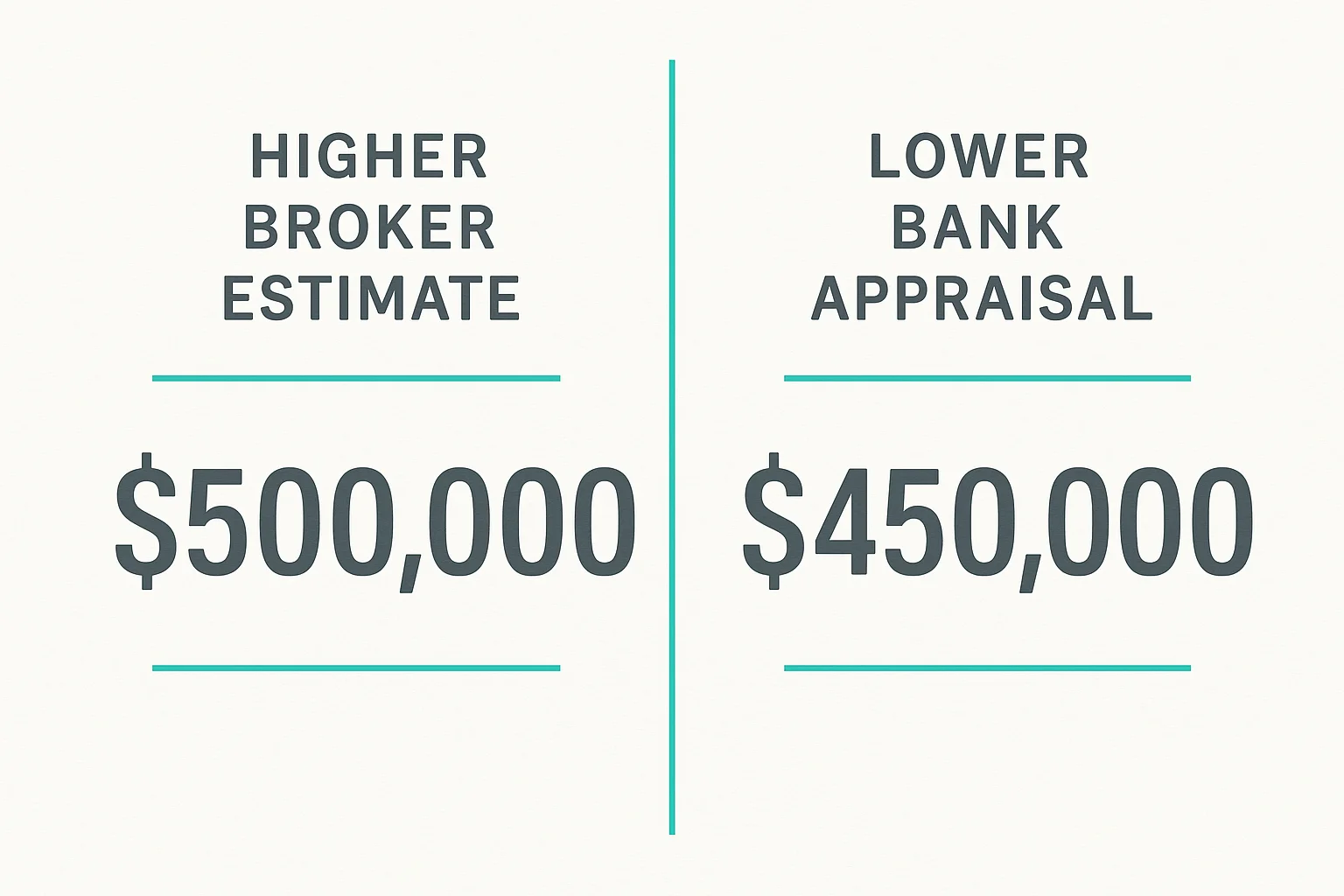
You agreed on $1.8 million. The appraisal came back at $1.3 million. Here’s exactly what to do next.
You spent three months finding the right HVAC company. You negotiated a price the seller accepted. You submitted your SBA loan application. And then the bank’s third-party appraiser came back with a number $500,000 below what you agreed to pay.
Your loan just got smaller. The deal is in jeopardy. And you have about 10 days to figure out whether this acquisition is still alive.
This happens in an estimated 30–40% of SBA-financed acquisitions. If you’re buying an HVAC company with an SBA 7(a) loan, you need to understand why appraisal gaps happen, what your options are, and how to structure deals that anticipate this risk from day one.
Why Appraisal Gaps Happen in HVAC Deals
The root cause is simple: brokers and SBA appraisers use different valuation methodologies.
Broker Valuations: Optimistic by Design
Business brokers typically value HVAC companies using multiples of SDE (Seller’s Discretionary Earnings). They’ll look at trailing twelve months, add back the owner’s salary and perks, and apply a market multiple — usually 2.5x–4x for HVAC companies in the sub-$2M range.
The broker’s job is to set an asking price that attracts the seller as a client. They’re incentivized toward the high end of the range.
SBA Appraisals: Conservative by Mandate
SBA-approved appraisers use the income approach — discounting future cash flows using rates that reflect the risk of a small, owner-dependent business. They also weigh the asset approach (what the tangible assets are worth) and the market approach (comparable transactions).
The appraiser’s job is to protect the SBA lender’s collateral position. They’re incentivized toward conservative assumptions.
Specific HVAC Factors That Create Gaps
- Seasonal distortion. If the broker normalized earnings over a strong year and the appraiser normalizes over three years (including a weak one), the numbers diverge.
- Goodwill discount. SBA appraisers heavily discount intangible value — reputation, customer relationships, brand recognition. For a 30-year-old HVAC company where most value IS goodwill, this cuts deep.
- Owner dependency. If the owner is involved in daily operations, the appraiser applies a “key person” discount. The broker ignored it.
- Equipment depreciation. The fleet and shop equipment on the balance sheet may be fully depreciated for tax purposes — the appraiser may value them at replacement cost or somewhere in between, but rarely at what the seller thinks they’re worth.
- Maintenance agreement uncertainty. Brokers count every maintenance agreement at full annual value. Appraisers may discount for historical churn rates.
The most common gap: 15–30% below the agreed purchase price. A company listed at $1.8M that appraises at $1.3M–$1.5M is typical, not exceptional.
The Five Options When Your Appraisal Comes in Low
You have more options than you think. Here they are, ranked by frequency of use:

Option 1: Renegotiate the Purchase Price
The most straightforward path. You go back to the seller and say: “The bank’s independent appraisal valued your company at $1.3M. I can’t get a loan for more than that. Can we adjust the price?”
When this works:
- The seller has limited other buyers
- The business has been on market for 6+ months
- You have a good relationship with the seller
- The seller’s broker is experienced and expected this
When it doesn’t:
- The seller has another offer at the original price
- The seller is emotionally anchored to “their number”
- The seller’s broker is combative or inexperienced
Option 2: Bridge the Gap with Seller Financing
This is the most common solution and works in the majority of cases. The seller carries a portion of the purchase price as a promissory note.
Structure: The seller finances the gap between the appraisal and the agreed price. If you agreed on $1.8M and the appraisal came in at $1.3M, the seller carries a $500K note (or some portion of it — often combined with a slight price reduction).
SBA Rules: The seller note must be on “full standby” for the first 24 months. That means zero payments — no principal, no interest — for two years. After standby, it typically amortizes over 7–10 years at 4–6% interest.
Why sellers agree: They get their total price. They just get a portion of it over time rather than at closing. For a retiring HVAC owner with no immediate need for all the cash, this is often acceptable.
Option 3: Increase Your Equity Injection
If you have additional capital available, you can bridge part of the gap yourself. The SBA typically requires 10–20% equity — but there’s no maximum. If you put in 30% instead of 15%, the loan amount decreases and the appraisal gap becomes less relevant.
Reality check: Most first-time HVAC buyers don’t have an extra $200–500K lying around. This option exists, but it’s rarely the primary solution.
Option 4: Challenge the Appraisal
Appraisals aren’t infallible. You can request a reconsideration if:
- The appraiser used incorrect financial data
- Comparable transactions were missed or inappropriate
- The methodology contained errors (wrong discount rate, incorrect revenue figures)
- You can provide 3–5 additional comparable sales that support a higher value
Important: Don’t challenge an appraisal just because you don’t like the number. Reconsiderations succeed when there are factual errors or clear methodological problems — not because the buyer wants a bigger loan.
Some lenders will order a second appraisal from a different firm. This costs $3,000–$7,000 and takes 2–4 weeks.
Option 5: Walk Away
Your LOI should contain a financing contingency that lets you exit the deal without penalty if you can’t secure financing at agreed terms. If the appraisal gap is too wide (more than 25%) and the seller won’t budge, this may be the right call.
Walking away isn’t failure. It’s math. More on this below.
The Seller Financing Bridge: How It Actually Works
Because this is the most common solution, here’s the detail:
Typical Structure for a $1.8M HVAC Company:
| Component | Amount | Terms |
|---|---|---|
| SBA 7(a) Loan | $1,170,000 | 10-year, Prime + 2.75% (~11.25%) |
| Buyer Equity | $180,000 | 10% of appraised value |
| Seller Note | $450,000 | 24-month standby, then 8-year amortization at 5% |
| Total | $1,800,000 |
The seller’s perspective: They receive $1,350,000 at closing (loan proceeds + buyer equity) and a promissory note for $450,000 that starts paying in year 3. With interest, they’ll receive approximately $510,000 over the life of the note.
The buyer’s risk: After the 24-month standby period, you’re servicing TWO notes — the SBA loan (~$16,000/month) and the seller note (~$5,500/month). Your combined debt service is ~$21,500/month. If the business only generates $18,000/month in cash flow after operating expenses, you have a problem.
Before agreeing to a seller note bridge: Model your cash flow with both debt payments active. If the math doesn’t work in year 3, the deal structure doesn’t work — regardless of what you negotiate today.
Platforms like Lendesca can help you identify lenders whose appraisal standards and deal flexibility match your specific situation — because not all SBA lenders treat appraisal gaps the same way.
How to Structure Offers That Anticipate Appraisal Risk
The best time to handle an appraisal gap is before it happens:
Include Explicit Appraisal Language in Your LOI
Don’t just have a generic “financing contingency.” Add specific language: “Purchase price subject to adjustment based on SBA-required third-party business appraisal. If appraisal is below purchase price, parties agree to negotiate in good faith on revised terms.”
Price Your Offer Based on SBA Methodology
Before you submit an LOI, estimate what an SBA appraiser would conclude — not what the broker’s listing says. Use the income approach:
- Take normalized EBITDA (not SDE)
- Apply a capitalization rate of 20–30% (reflecting small business risk)
- Add tangible asset value at fair market (not book) value
If your estimate is significantly below the asking price, you already know a gap is coming. Structure your offer accordingly.
Build Seller Financing Into Your Initial Offer
Rather than offering $1.8M cash and being surprised when the appraisal comes in low, offer $1.8M structured as: “$1.35M at closing via SBA financing, plus a $450K seller note on 24-month standby.”
This normalizes the split from the beginning. The seller sees their total price and understands the structure before you’re in crisis mode.
Get Your Own Informal Valuation First
For $2,000–$5,000, you can hire a business appraiser (or ask your SBA lender for an informal opinion) BEFORE you submit an LOI. This won’t be binding on the bank, but it gives you a realistic range and prevents you from offering $1.8M for a business that’s clearly worth $1.2M.
Have “The Conversation” with Your Lender Before You Offer
Ask your SBA lender: “Based on the financials I’ve shared, what do you think this business would appraise for?” Most experienced lenders will give you a range. If their range is 20% below the asking price, you know what’s coming.
When the Gap Is Too Wide: The Walk-Away Decision
Sometimes the right answer is no.
If the gap exceeds 25%, the deal is probably mispriced — not under-appraised. A business listed at $2M that appraises at $1.4M isn’t suffering from a conservative appraiser. It’s suffering from an unrealistic seller (or an irresponsible broker).
The sunk cost trap is real. By the time the appraisal comes back, you’ve likely spent:
- $5,000–$15,000 in legal fees
- $3,000–$8,000 in due diligence costs (environmental, appraisal, QofE)
- 60–90 days of time and emotional energy
- Potentially an earnest money deposit ($10,000–$50,000)
None of that money comes back if you close a bad deal. But your financing contingency should protect your earnest money deposit if you walk away due to inability to secure financing.
The 60–90 day rule: Many sellers who refuse to renegotiate will come back 2–3 months later — after the next buyer encounters the same appraisal gap and the same impasse. The second time around, the seller is more realistic.
Your earnest money is protected. A properly drafted LOI with a financing contingency gives you a clean exit. Don’t let emotional attachment to “the deal” override mathematical reality. There will be other HVAC companies for sale. There are always other HVAC companies for sale.
Key Takeaways
- Appraisal gaps are normal. They happen in 30–40% of SBA deals. Don’t panic.
- Seller financing bridges most gaps. The 24-month standby note is the standard solution.
- Anticipate the gap. Price your offers based on income-approach methodology, not broker multiples.
- Model the full debt load. Can the business service both the SBA loan AND the seller note after standby? If not, the structure is broken.
- Walk away if the math doesn’t work. Your negotiation leverage comes from willingness to leave, not from desperation to close.
The appraisal gap isn’t a bug in the SBA process — it’s a feature. It’s the system telling you what an independent professional thinks the business is actually worth. Listen to it. Negotiate around it. But don’t ignore it.