
PE-backed HVAC companies spend $30K–$50K a month on digital advertising. They offer signing bonuses to poach your best techs. They undercut on price to grab market share. Here’s how you win anyway — not by matching their spending, but by doing the things they structurally cannot.
You closed. Congratulations. Now look up from the paperwork.
There’s a good chance a PE-backed HVAC chain is operating in your market, or will be within 18 months. They’ve got a national brand, a seven-figure marketing budget, and a dedicated recruiter whose full-time job is hiring technicians away from independents like you.
This isn’t an abstract threat. PE firms completed over 200 HVAC acquisitions in 2024 alone. The consolidation is active and accelerating.
But here’s what nobody tells you: the independent owner’s playbook against these guys is not complicated. It’s just different from what they’re running. You don’t compete by matching their ad spend. You compete by being something they cannot be — local, personal, present, and trusted. That’s a real structural advantage. The tactics below are how you turn it into revenue.
How to Recognize You’re Competing With a Roll-Up
Before you can fight it, you need to see it clearly.
PE-backed HVAC platforms often keep local branding for a year or two after acquisition. The name on the truck might still say “Miller’s Heating & Cooling” even though a private equity fund owns it. You won’t always know immediately.
Here’s how to spot them:
- Google Ads dominance. If a local competitor is running Google Local Services Ads and standard search ads simultaneously, spending like they’re not tracking ROI, they’re probably PE-backed. Independents don’t spend at that volume.
- Uniform branding across a wide geography. Multiple service areas, consistent logo treatment, professional photography throughout — this is a platform operating at scale.
- Aggressive recruiting language. “Join our team” ads with explicit signing bonuses, relocation assistance, or benefit packages that don’t match typical independent comp — that’s a rollup recruiting engine.
- Rapid price discounting. First-tune-up-free, $49 diagnostic specials, aggressive coupon marketing. They’re buying market share. They have the budget to absorb the short-term loss.
- High Glassdoor turnover signals. PE-backed operations often have reviews that mention corporate culture, inconsistent management, or feeling like “just a number.” Search them before you dismiss them.
Knowing what you’re up against helps you stop reacting and start competing.
Where PE-Backed Chains Have Real Advantages
Credit where it’s due. These operators are not stupid and they’re not bluffing.
Marketing Budget
The average PE-backed HVAC operator spends $30K–$50K per month on digital marketing. That buys: Google Local Services Ads, display retargeting, SEO content farms, paid social, and often a national call center that answers 24/7. You’re spending $3K–$5K if you’re being deliberate. This is a 10x gap, and it’s real.
Tech Recruitment Leverage
With technician wages rising 8–12% annually, PE firms offer what you often can’t match outright: signing bonuses of $5K–$15K, full benefits, fleet vehicles with better specs, and national career paths. They also have HR infrastructure. When a tech wants to push back on a write-up, there’s an HR department to complain to. For some techs, that feels safer than working for an owner who’s also the owner.
Vendor Pricing
At scale, PE platforms negotiate better equipment pricing from distributors, better financing terms on fleet, and preferred contractor status with manufacturers. You’re probably paying retail or near it.
24/7 Call Answering
PE operations staff call centers around the clock. When your phone goes to voicemail at 9pm and theirs doesn’t, you lose that call.
Know these advantages. Don’t pretend they’re not real. Then read the next section.
Where PE-Backed Chains Are Structurally Weak
This is where the playbook lives. These are not temporary weaknesses. They’re baked into the model.
Technician Turnover
The signing bonus gets the tech in the door. What keeps them is culture, and PE-backed operations tend to have high turnover — often 35–50% annually in the first few years post-acquisition. That turnover is expensive (recruiting, training, licensing) and it shows. Customers notice when a different person shows up every year. Customers remember when the same guy has been servicing their unit for six years.
Customer Relationship Depth
A PE platform’s CSR knows your name and your address. Your tech knows your name, your dog’s name, which unit is giving you trouble, and that you prefer calls before noon. That relationship has economic value. Customers with relationships cancel service agreements less, refer more, and are more price-tolerant.
Local Market Knowledge
You know which neighborhoods have aging equipment installed in tight attic spaces. You know the local codes that just changed. You know which distributors actually have the part on a Friday afternoon. A PE platform’s regional manager does not. Your techs do.
Decision-Making Speed
Need to cut a deal to keep a commercial account? You can decide in 30 seconds. A PE platform needs a regional ops manager, maybe a pricing committee. By the time they call back, you’ve already written the contract.
Community Presence
You can be at the little league game. You can sponsor the high school booster club. You can have your face on a truck and your name mean something on the next block over. A corporate entity can buy ads that look like community presence. It’s not the same thing, and locals know the difference.
Building Your Review Engine
This is your highest-ROI marketing activity. Full stop.
PE firms spend $30K a month to put their name in front of people who’ve never heard of them. A 5-star Google review from a satisfied customer puts your name in front of someone actively searching, with social proof, for approximately zero dollars. You need to generate reviews systematically, not accidentally.
The Mechanical System
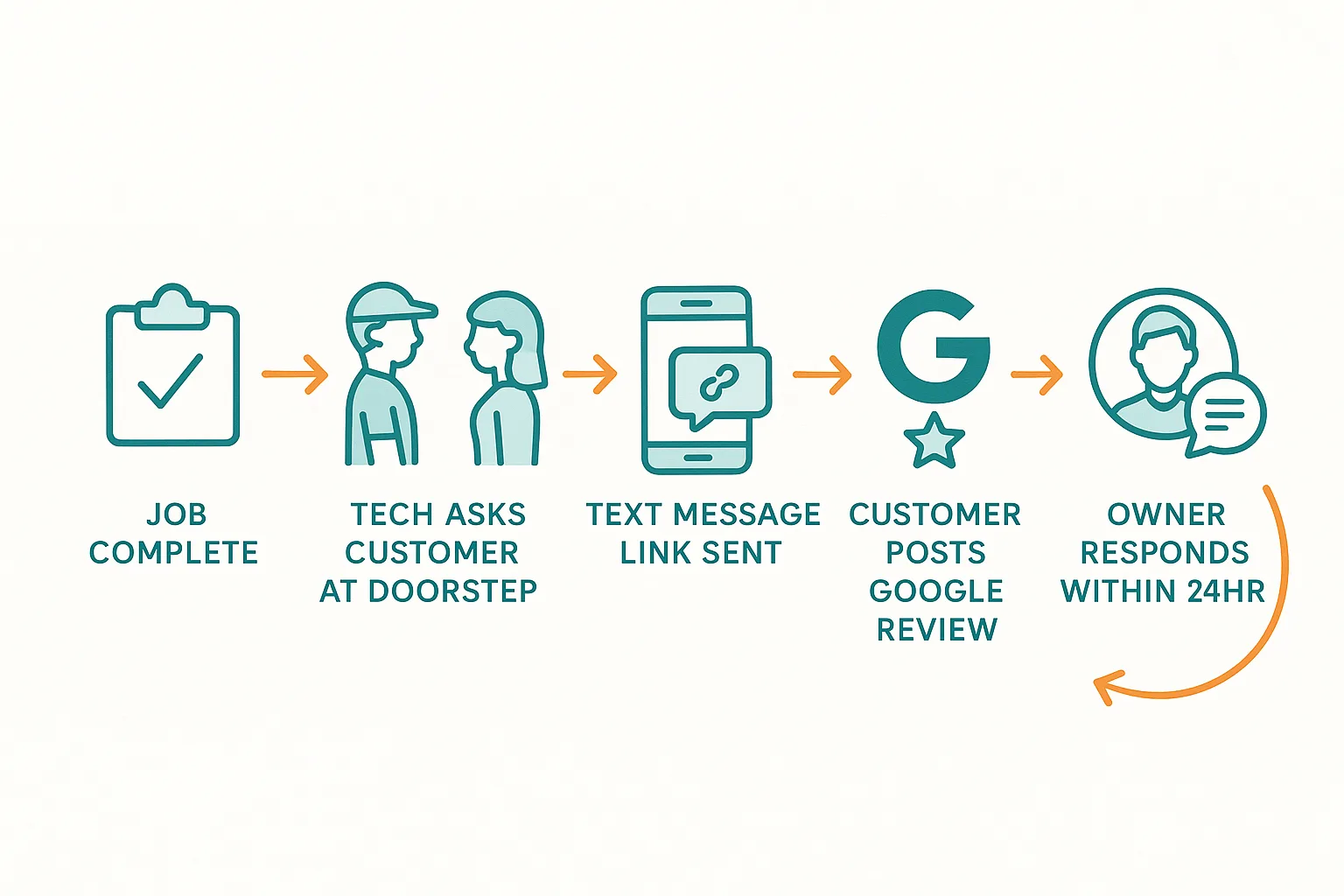
- Ask at job completion. Not later. Not in a follow-up email three days later. The moment the tech closes out the job and the customer is pleased, that’s when you ask. “If you have 30 seconds, a Google review would mean a lot to us — want me to text you the link right now?”
- Text beats email. A review request sent via text converts at 2–3x the rate of email. Use your field software (ServiceTitan, Jobber, Housecall Pro) to trigger it automatically. If you’re not on scheduling software yet, set a manual trigger.
- Make it one step. A direct link to your Google review page. Not “go to Google and search for us.” The link. If they have to work for it, most won’t.
- Respond to every review. Every 5-star gets a genuine response. Every 3-star or below gets a direct, calm, professional reply within 24 hours. This is not just PR — it signals to potential customers watching from the sidelines that you’re accountable.
- Volume compounds. 100 reviews is better than 80. 150 is better than 100. Ask on every job, every season, every service call. Never stop.
The Response Protocol
For negative reviews: acknowledge, don’t argue, offer to resolve offline. “We’re sorry your experience didn’t meet expectations — this isn’t our standard. Please call us directly at [number] so we can make it right.” Short. Professional. Never defensive.
For positive reviews: personalize them. “Thanks, Sandra — the mini-split install on your sunroom was a fun one. Glad it’s running well.” Customers reading reviews see you’re paying attention. That builds trust before they even call.
The Recurrence Strategy: Winning the Relationship, Not the Transaction
PE platforms optimize for customer acquisition. You optimize for customer retention. These require fundamentally different tactics.
A customer who buys a maintenance agreement from you is worth 3–4x a one-time service customer over five years. They call you first. They refer neighbors. They don’t comparison shop for a tune-up.
Build a Maintenance Agreement Book That Sticks
- Price agreements for value, not just margin. A $20/month agreement that includes priority service, discounts on repairs, and a genuine relationship is worth more than a $15 bare-bones one that people cancel.
- Make cancellation a conversation, not a click. PE operations let customers cancel online. You should call. Not to pressure — to understand. Sometimes people cancel because of a billing confusion that takes 90 seconds to fix.
- Track your agreement renewal rate. Industry benchmark is 75–80%. If you’re below that, find out why before you try to grow the book.
The Seasonal Touch System
Twice a year, your existing customers should hear from you — proactively, before they need you.
- April/May: “Summer’s coming. Time to get your A/C dialed in before the first heat wave. We have spring slots available.”
- October/November: “Heating season starts earlier than people think. Last year we had our first emergency service calls in late October. Here’s what you can do to avoid it.”
This is a text or email to your customer list. It costs almost nothing. It reminds them you exist, that you care, and that you’re ahead of the problem. PE call centers don’t do this at scale with any authenticity. You can.
First-Party Data Is Your Actual Asset
Every customer in your CRM is yours. You know their equipment, their install date, their preferences. PE firms spend enormous amounts on advertising because they’re constantly trying to find new customers. You already have customers. Work them first.
At acquisition, your predecessor probably had a customer list in some form. Import it, clean it, and use it. Every customer with equipment that’s 8+ years old is a replacement conversation waiting to happen. Every maintenance agreement customer who hasn’t had service in 14 months is a lapsed customer worth reactivating. You don’t need $50K in Google ads for that. You need a segmented list and a phone call.
Retaining Techs When PE Offers Signing Bonuses
A PE-backed competitor will try to recruit your best tech. Probably more than once. Here’s how to make the offer less attractive.
What Techs Actually Want
Pay is important. But in my experience, it’s usually fourth or fifth on the list. Above it:
- To be treated like a professional. If a tech feels like a number, they leave. If they feel like the person who keeps the lights on, they stay.
- Clear advancement. Lead tech, service manager, potential equity — show the path explicitly and revisit it annually. PE firms offer titles. You can offer genuine upward movement.
- Predictable schedule. A rotation that doesn’t wreck their life. Paid on-call that’s actually fair.
- Equipment and support. Good vans, stocked inventory, working iPads, and a dispatch system that doesn’t make their day a circus.
The Compensation Architecture
You can’t necessarily match a $10K signing bonus head-to-head. But you can offer:
- Annual profit-sharing. Even 3–5% of net profit distributed equally does two things: it aligns incentives and it creates a retention mechanism. Mid-year departure means they leave profit on the table.
- Tool stipend or buy-out. Techs care about their tools more than most owners realize. Help with tool costs or buy their specialty tools and let them use them — it matters.
- Retention bonuses. A $2K bonus on the three-year anniversary is a real thing. Simple, effective, and far cheaper than replacing a tech.
Have the Conversation Before They Get the Offer
Don’t wait for a tech to tell you they’re looking. Have annual 1:1 reviews — not performance reviews, career conversations. “Where do you want to be in three years? What would make this job better? What would make you leave?” Know the answer before the recruiter calls.
For a deeper framework on keeping your team through ownership transitions, see the full employee retention guide.
Pricing Strategy: When to Compete on Price, When to Compete on Value
PE firms will undercut you on acquisition calls — first-time customers, diagnostic fees, promotional tune-ups. They’ll absorb the short-term loss to get the customer in the system.
You probably shouldn’t try to match that. Here’s how to think about it instead:
Don’t Win the Race to the Bottom
On commoditized, price-sensitive calls — basic diagnostics, single-part repairs on aging equipment — a customer who chooses you because you’re $15 cheaper will leave you the same way. Focus on customer lifetime value, not one-time ticket size.
Compete Hard on Quality, Speed, and Relationships
Premium customers — commercial accounts, homeowners with newer equipment, people who’ve just bought a home — will pay more for reliability and accountability. Price accordingly. Don’t apologize for charging full rate for a tech who shows up on time, communicates clearly, and fixes it right the first time.
Be Explicit About What You’re Offering
When a customer tells you they got a cheaper quote, don’t get defensive. Ask questions: “Was that a licensed contractor? Who’s responsible if something goes wrong? Will they be the ones to service it next year?” Not as an attack — as genuine clarification. A lot of customers have never thought through what they’re actually buying.
Know Your Floor
Know your loaded cost per tech per hour. Include wages, burden, insurance, vehicle, dispatch, overhead allocation. If you don’t know this number, you’re guessing. And you’ll lose money on jobs you thought were profitable.
Community Trust as a Competitive Moat
This is the one thing PE cannot replicate at scale. A national rollup can sponsor a Little League team in your zip code. They cannot have the owner show up to the games.

Presence Is the Product
- Sponsor local events at the level that gets you visible: the high school athletic booster, the chamber of commerce golf tournament, a neighborhood association newsletter. These are $500–$2,000 commitments that put your name in front of your exact target customer repeatedly.
- Show up personally when you can. A face attached to a company name is worth more than a logo.
- Let your techs be ambassadors. A tech who’s been in this community for ten years knows more people in your service area than any marketing campaign. Make sure they know you’re proud to be local.
Use Your Local Story
The “family-owned since 1987” angle isn’t just sentimental. It’s a specific claim about accountability and continuity that a PE rollup cannot make. If you’re a new owner, your story is: “I bought this business because I believe in it and I’m here for the long haul.” That’s also a story. Tell it.
On your website. On your truck. In your email signature. When customers ask, give them a real answer.
Local Partnerships
Build relationships with:
- Real estate agents and property managers. A relationship with two or three active agents in your market produces consistent referral flow.
- Home inspectors. They flag HVAC issues constantly. A referral relationship with a few inspectors is worth real money.
- Plumbers and electricians. Cross-referral relationships with trades that don’t compete with you are cheap to build and produce warm leads.
PE firms have marketing departments. They don’t have time to build individual relationships with every real estate agent in your zip code. You do.
Frequently Asked Questions
Can an independent HVAC owner really compete with PE-backed companies?
Yes — and the independents who understand where PE is structurally weak are doing it effectively. The mistake is trying to compete on the same terms: ad spend, volume, brand awareness. The winning strategy is competing on relationship depth, response time, technician continuity, and community presence. Those are real advantages that scale of money does not eliminate.
Should I lower my prices to compete with PE promotions?
Not as a default strategy. PE promotional pricing is designed to acquire customers at a loss — they’re buying market share. If you chase that, you lose money and train your market to expect discounts. Compete on value for quality-seeking customers and let the price-seekers go. Your best customers aren’t choosing you because you’re the cheapest.
How do I keep my best techs from leaving for a PE-backed company offering signing bonuses?
Start with the honest conversation about what they actually want. Pay is important but rarely the only thing. Career path, quality of day-to-day work life, schedule predictability, and feeling valued matter more than most owners assume. Build in retention mechanisms — profit sharing, milestone bonuses, advancement clarity — and review them annually before someone else does.
What’s the single highest-ROI competitive move for a new independent owner?
Build a systematic review engine. Every job, every customer, a text with a direct review link. Respond to every review personally. At 100+ Google reviews with a 4.8+ average, you will outrank PE competitors on local search for many queries — regardless of how much they’re spending on ads. Organic local trust is the one thing money can’t fully buy.
Is it worth trying to build a maintenance agreement book against PE competition?
Absolutely. A customer with a maintenance agreement is 3–4x more valuable over five years than a one-time customer. PE platforms want agreement books too — but they’re building from acquisition and incentivizing CSRs at scale. You’re building one relationship at a time. That tends to produce stickier agreements and higher renewal rates. It’s slower to build and harder to erode.
How should I think about my marketing budget vs. a PE competitor’s?
Stop trying to match the spend and focus on efficiency. Your $3K–$5K/month should be almost entirely allocated to Google Business Profile optimization, Local Services Ads (where ROI is trackable), and review generation. Don’t dilute it across platforms you can’t measure. The PE firm’s $40K/month buys reach; your $4K buys relevance to customers already looking for you.
PE-backed HVAC companies are real competition and they’re not going anywhere. But the independent owner who understands their own structural advantages — and stops trying to out-advertise a company with 10x the budget — has a very real path to building a dominant local business.
Out-remember them, don’t out-advertise them. Build the relationship book they can’t replicate. Keep the techs who know your customers by name. Show up at the games. Ask for the review.
That’s not a consolation prize for being small. That’s the actual playbook.