
You bought a business that prints money from May through September. The other seven months are what separate owners from former owners.
Nobody warns you about February.
They warn you about SBA paperwork, about due diligence, about seller’s discretionary earnings and how to read a P&L. They do not warn you about staring at your bank account in the second week of February, watching it drop like a condenser pressure reading with a bad TXV, while your loan payment sits there on autopay like it doesn’t care what season it is.
Because it doesn’t.
I watched three first-year owners nearly go under — not because they bought bad businesses, but because they bought seasonal businesses and budgeted like they weren’t. This is the guide I wish I’d had. Real numbers, real months, real strategies. Not “manage your cash flow better” — actual math you can use.
July Was Great. February Is Coming.
Here’s the number that matters: the gap between your best month and your worst month.
For a typical 10-person residential HVAC shop doing $1.5–2M annually, peak month revenue runs $200–300K. That’s June or July, depending on your market. You’re running five trucks, the phone won’t stop, and every tech is pulling overtime.
Your trough month — January or February — looks like $60–90K. Sometimes less.
That’s a $165K swing. In the same business, with the same fixed costs, paying the same loan.
Established owners know this rhythm. They’ve internalized it over decades. They stockpiled cash in August like squirrels before winter. Their monthly nut is dialed in. They sleep fine in January because they’ve done this twenty times.
You haven’t done it once.
This is the number one financial stress for first-year HVAC owners. Not finding techs. Not losing a big customer. Not equipment costs. It’s the slow, grinding realization that your expenses don’t take the winter off — and your revenue does.
If you’re reading this in June, you have time. If you’re reading this in November, you need to move fast. Either way, keep reading.
The HVAC Cash Flow Calendar: What Actually Happens Each Month
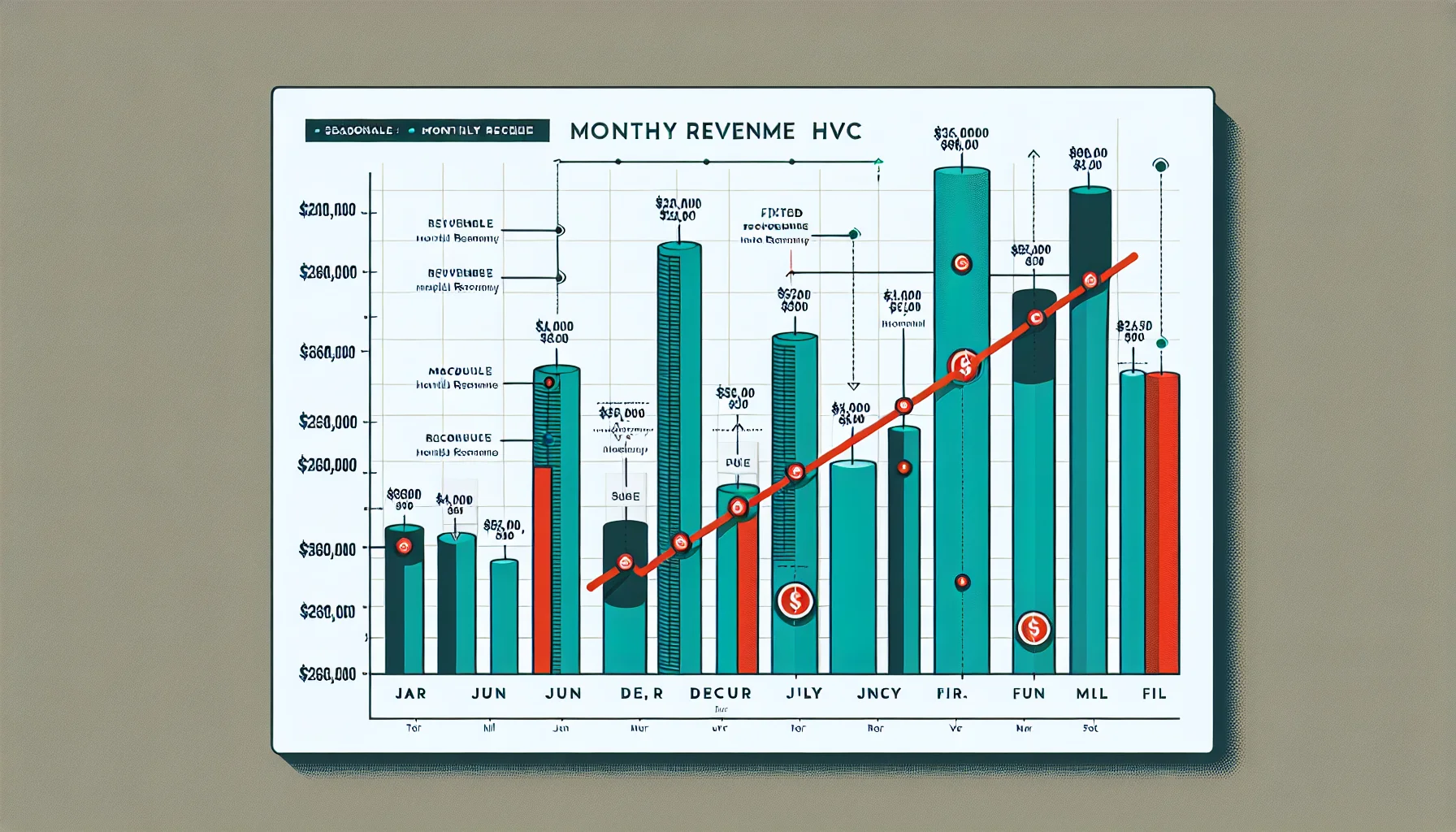
Let’s put real percentages on it. For a $2M residential-focused HVAC company in a four-season climate, here’s roughly how revenue distributes across the year.
Month-by-Month Revenue Share
| Month | % of Annual Revenue | Revenue ($2M co.) | The Vibe |
|---|---|---|---|
| January | 5–6% | $100–120K | Slow. Furnace repairs trickle in. |
| February | 4–5% | $80–100K | The bottom. Pray for a cold snap. |
| March | 5–6% | $100–120K | Still slow. Maintenance season starting. |
| April | 6–7% | $120–140K | Pre-cooling tune-ups picking up. |
| May | 10–12% | $200–240K | First hot week = phone explosion. |
| June | 14–16% | $280–320K | Peak month #1. Full sprint. |
| July | 14–16% | $280–320K | Peak month #2. Overtime everywhere. |
| August | 12–13% | $240–260K | Still strong. Slowing slightly. |
| September | 7–8% | $140–160K | The cliff. It comes fast. |
| October | 6–7% | $120–140K | Heating tune-ups. Shoulder season. |
| November | 6–7% | $120–140K | First cold snap helps. Furnace season. |
| December | 5–6% | $100–120K | Holiday slowdown. Emergency calls only. |
Your numbers will differ by market. Phoenix has a longer cooling season but almost no heating revenue. Minneapolis has serious heating demand but a shorter summer. The Bureau of Labor Statistics tracks regional HVAC employment patterns that can help you estimate your local seasonality. Adjust accordingly — but the shape of the curve is universal.
The Two Danger Zones
Danger Zone #1: March–April. Cooling season hasn’t started yet. Heating emergencies have dried up. You’re in no-man’s-land. Revenue is 10–13% of annual in these two months, but your costs are 16.7% (two out of twelve months of fixed expenses).
Danger Zone #2: September–October. The post-summer cliff. Revenue falls 50% in four weeks. You just had your best quarter ever and suddenly the phone goes quiet. Psychologically, this one is worse. You got used to the money. Now it’s gone.
These four months — March, April, September, October — produce roughly 15–20% of your annual revenue but represent a third of the year. That math doesn’t work unless you planned for it.
Revenue Mix Changes the Shape
Here’s the thing most first-year owners miss: not all $2M HVAC companies have the same curve.
- Install-heavy companies have the most dramatic peaks and valleys. Big system replacements happen in summer. Winter installs are rare.
- Maintenance-heavy companies have flatter curves. If 35–40% of revenue comes from service agreements, your off-season floor rises significantly.
- Commercial-focused companies are the flattest. Commercial maintenance contracts pay monthly, year-round.
When you did due diligence, you should have seen the revenue mix. If 70%+ of revenue comes from install work concentrated in four months, your off-season cash crunch will be severe. If you have a strong maintenance base, it’s manageable.
Either way, you need a plan.
Your Fixed Costs Don’t Take the Winter Off
This is the part that makes first-year owners lose sleep. Let me lay out the real monthly nut for a 10-person HVAC shop.
The Monthly Nut
- Payroll (including taxes and benefits): $65,000–$85,000
- SBA loan payment: $8,000–$12,000
- General liability + workers’ comp insurance: $2,000–$4,000
- Rent/mortgage on shop space: $3,000–$6,000
- Vehicle payments + fuel + maintenance: $2,000–$4,000
- Software, phones, internet, dispatch tools: $1,000–$2,000
- Miscellaneous (uniforms, office supplies, accounting): $1,000–$2,000
Total fixed monthly overhead: $82,000–$115,000.
That number exists in February just like it exists in July. Read it again. Let it sink in.
The Math That Matters
Now put those two numbers side by side.
- February revenue: $80,000–$100,000
- February expenses: $82,000–$115,000
You’re either breaking even or losing money. For potentially four to five months of the year.
Even if you’re only $15K underwater per month for four months, that’s $60K in negative cash flow you need to cover from somewhere. For some businesses, the gap is wider — $20–30K per month for four or five months. That’s $100–150K in cumulative negative cash flow before spring kicks in.
Find Your Breakeven Month
Sit down with your P&L. Look at each month of the trailing twelve. Identify which months the business actually lost money — where total expenses exceeded total revenue. If you need help reading those statements, start with the financial literacy crash course.
For most residential HVAC companies, you’ll find two to four months in the red. Those are your breakeven months. Everything you do from here is about surviving those months.
Critical point: Your breakeven month is not the same as SDE breakeven. SDE adds back your salary and discretionary expenses. Cash flow breakeven means the bank account isn’t shrinking. That’s the number that matters when the bills are due.
The Cash Reserve Formula
Here’s where I’m going to give you a number that makes you uncomfortable.
The Standard Advice
The SBA and most small business advisors recommend 3–6 months of operating expenses as a cash reserve. For most businesses, that’s reasonable.
For HVAC, go with six. Minimum.
The Real Number
For a $2M company with $80–115K in monthly overhead:
- 3 months reserve: $240,000–$345,000
- 6 months reserve: $480,000–$690,000
Yes, really. Half a million dollars sitting in an account doing nothing but keeping you alive from November through March.
I know what you’re thinking. “I just put $300K down on this business. I don’t have another $500K lying around.”
If You Used All Your Cash for the Down Payment
You have a problem. Not an insurmountable one, but a real one that needs addressing right now — not in October. Understanding what your acquisition actually costs on a monthly basis is essential before solving this.
Options, in order of preference:
- Negotiate a working capital reserve into the deal. If you haven’t closed yet, this is the play. Ask for $100–150K in working capital to remain in the business at close. Good brokers build this in. Bad ones don’t.
- Establish a line of credit immediately. Day one. While your financials still show peak-season revenue. More on this below.
- Build the reserve during your first peak season. Aggressive but doable. Set aside 15–20% of every dollar above your breakeven point from May through August.
- Seller financing with seasonal flexibility. If the seller carried a note, talk to them about reduced winter payments with a true-up in summer. Many sellers understand the cycle. Read more about how seller financing works in HVAC deals.
Building the Reserve During Peak Season
Here’s the discipline that separates surviving owners from struggling ones.
The rule: 15–20% of every dollar above breakeven goes into a separate reserve account. Do not touch it.
Example: Your breakeven is $95K/month. In June, you bring in $300K.
- Above breakeven: $205K
- Reserve set-aside (18%): $36,900
- Available for operations and profit: $168,100
Do that for four peak months and you’ve got $100–150K in reserve before autumn hits. It’s not the full six months, but it’s enough to survive year one while you build toward the target.
Open a separate savings account for this money. Not your operating account. Not your personal account. A dedicated reserve account that you only access when monthly cash flow goes negative. The psychological separation matters. Money in your operating account gets spent.
Five Strategies That Actually Flatten the Curve
The long-term play isn’t just surviving the off-season. It’s making the off-season less off. Here are five strategies ranked by impact and difficulty.
1. Maintenance Agreements: The Single Best Thing You Can Do
Maintenance agreements are the backbone of off-season revenue. Full stop.
The math: A typical residential maintenance agreement runs $150–$250/year for two visits (spring and fall tune-up). If you grow from 200 agreements to 600, here’s what happens:
- Additional annual revenue: 400 agreements × $200 average = $80,000
- Revenue timing: Half in spring (March–April), half in fall (September–October) — directly into your danger zones
- Upsell revenue: Each maintenance visit generates $150–$300 in average repair/upgrade recommendations. At a 30% close rate, that’s another $36,000–$72,000 annually.
- Net off-season impact: Your trough months improve by 30–40%.
How to grow agreements from 200 to 600:
- Offer every service call customer a maintenance agreement. Every single one. Train your techs to present it.
- Price it as a no-brainer. $189/year for two tune-ups that would cost $99 each, plus 15% off repairs and priority scheduling. The customer saves $9 and you get recurring revenue and two guaranteed upsell opportunities.
- Run a spring and fall “enrollment campaign” — direct mail, email, door hangers in neighborhoods you already service.
- Don’t discount the agreement itself. Discount the signup: “First year at $149” or “Sign up today and get a free filter delivery.”
This isn’t a one-quarter project. Budget 18–24 months to go from 200 to 600. But start now. Every agreement you add before October is money in the danger zone.
2. Heating Push: If You’re Cooling-Heavy, Winter Is Your Growth Opportunity
Most HVAC companies I see at acquisition are 60–70% cooling revenue. That’s because cooling season is dramatic — 95 degrees, no AC, emergency call. Heating failures are slower, less urgent, and customers layer up before they call.
But heating work exists. And if the previous owner neglected it, it’s your growth opportunity.
- Furnace tune-ups in October–November. Same model as AC tune-ups in spring. Market them the same way.
- Heat pump conversions. The electrification wave is real. The Department of Energy reports growing consumer interest in heat pump technology. Homeowners replacing furnaces with heat pumps is a year-round sales opportunity, but the urgency peaks in fall.
- Ductwork and insulation. Winter is when homeowners notice drafts and cold rooms. Duct sealing and insulation work is profitable and schedulable.
- Emergency heating repair marketing. Increase your Google Ads and LSA budget for heating keywords from November through February. The previous owner may not have bothered.
A serious heating push can shift your revenue mix from 65/35 cooling-to-heating to 55/45 within two years. That alone shrinks your worst month by 15–20%.
3. Indoor Air Quality: Year-Round Revenue at High Margins
IAQ is the gift that keeps giving. It’s not seasonal. People care about air quality in January (dry air, flu season) and July (allergens, humidity). The EPA’s indoor air quality resources can help you educate customers on why this matters.
Products and price points:
- Whole-home air purifiers: $800–$1,500 installed. Margin: 50–60%.
- UV germicidal lights: $400–$800 installed. Margin: 55–65%.
- Whole-home humidifiers/dehumidifiers: $1,200–$2,500 installed. Margin: 45–55%.
- Duct cleaning partnerships: If you don’t do duct cleaning in-house, partner with a duct cleaning company for referral fees. $50–$100 per referral adds up.
- High-efficiency filtration upgrades: $200–$500. Easy add-on to any service call.
Average IAQ upsell: $800–$2,500 per job.
Train your techs to talk about air quality on every call. Not as a hard sell — as a genuine recommendation. “Hey, I noticed you don’t have any filtration beyond the standard 1-inch filter. With two dogs, have you thought about a media filter? Big difference in air quality and it protects your equipment.”
If every tech generates one IAQ sale per week during the off-season, that’s 20 additional sales across four months at an average of $1,200. That’s $24,000 in revenue at 50%+ margins during your weakest months.
4. Commercial Maintenance Contracts: Monthly Revenue Regardless of Season
Commercial maintenance contracts are the ultimate curve-flattener. A restaurant, an office building, a church — they need HVAC maintained twelve months a year. And they pay monthly.
The math on commercial:
- A small commercial contract (single-location restaurant, small office): $300–$600/month
- A mid-size commercial contract (multi-unit retail, medical office): $800–$2,000/month
- Ten small commercial contracts at $400/month = $48,000/year in monthly recurring revenue
The catch: Commercial work requires different skills, different insurance limits, and often different licensing. If you’re purely residential, this is a 12–18 month buildout. But it’s worth it.
Where to start:
- Businesses in the neighborhoods you already serve. You’re already driving past them.
- Your existing residential customers who own businesses. They know you, they trust you.
- Property management companies. They need reliable HVAC contractors and they have multiple properties.
Even five commercial contracts generating $2,500/month total changes your February math from painful to manageable.
5. Strategic Purchasing: Buy Smart When Others Aren’t Buying
This one doesn’t increase revenue, but it reduces costs during the months that matter.
- Refrigerant: Prices fluctuate 15–25% seasonally. Buy in February–March when demand is low. Store it. Use it in June–July when the same product costs significantly more. On a $2M company using $30–40K in refrigerant annually, that’s $5,000–$10,000 in savings.
- Equipment: Distributors run their best promotions in Q4 and Q1. If you know you’ll need inventory for spring installs, buy in January. Some distributors offer extended payment terms (net-60 or net-90) on off-season purchases — that’s free float.
- Marketing: Google Ads cost-per-click drops 20–30% for HVAC keywords in winter. Run your brand and maintenance campaigns when clicks are cheap. Build the pipeline so the phone rings in April.
- Vehicles: Fleet purchases in November–January often come at better prices. Dealers want to clear inventory before year-end. If you need a van, winter is when you buy it.
The Emergency Playbook: When Cash Gets Tight
Sometimes the plan doesn’t work. An unusually warm winter kills heating revenue. A major truck repair eats your reserve. A big commercial customer goes bankrupt owing you $30K. Things happen.
Here’s the playbook for when cash gets tight — in order of escalation.

Step 1: Establish a Line of Credit (Before You Need It)
This is the single most important piece of off-season financial infrastructure. And the time to get it is July, not February.
Banks approve lines of credit based on your financials. In July, your trailing-three-month revenue is $250K+/month. Your bank account is flush. Your P&L looks like a success story.
In February, your trailing-three-month revenue is $90K/month. Your bank account is thin. Your P&L looks like a business in trouble.
Same business. Same owner. Completely different lending decision.
Get a $50–100K business line of credit during peak season. Ideally from the same bank that holds your SBA loan — they already know you. The line sits there unused until you need it. You pay nothing (or a small annual fee) until you draw on it.
When February hits and you’re $15K short, you draw $15K, cover your obligations, and repay it in May when the money comes back. Interest on a $15K draw for three months at 8–10% is about $300–375. That’s the cost of sleeping at night.
Step 2: Accelerate Accounts Receivable
If you do commercial work, you have net-30 accounts. In the off-season, that 30-day float is cash you need now.
Tactics:
- Offer a 2% discount for net-10 payment. On a $5,000 invoice, that’s $100 to get your money 20 days faster. Worth it in January.
- Invoice immediately. Not “when we get around to it.” The day the work is done, the invoice goes out.
- Follow up on aging receivables. That $8,000 invoice from November that’s now 60 days past due? Call. Today. Be pleasant but direct: “Just checking in on invoice #1847. Can we get that processed this week?”
- Consider invoice factoring as a last resort. You’ll give up 2–5% of the invoice value, but you get cash in 24–48 hours. Only use this if you’re truly in a cash crunch — the cost adds up fast.
Step 3: Defer Non-Critical Spending
There’s a difference between cutting costs and deferring costs. In the off-season, defer everything that can wait until May without damaging the business.
Can wait:
- Fleet upgrades or additions
- Office renovation or equipment
- New software implementations
- Non-essential marketing experiments
- Uniform refresh
- Non-critical tool purchases
Cannot wait:
- Safety equipment and PPE
- Required licensing and continuing education
- Insurance premiums
- Tax obligations
- Payroll (never, ever late)
The fleet upgrade can wait until May. The new CRM can wait until May. That marketing initiative you’ve been excited about can wait until May. Preserve cash now. Spend when the money’s flowing.
Step 4: Talk to Your SBA Lender Early
If you see a month coming where you might miss a payment, call your lender before that month arrives. Not after.
SBA lenders have options, but only for proactive borrowers:
- Payment deferral: Some lenders will allow you to defer 1–2 payments to the end of the loan. You’ll pay interest, but you skip the principal portion.
- Seasonal payment restructuring: For businesses with documented seasonal patterns, some lenders will restructure to higher summer payments and lower winter payments. This is easier to negotiate at origination than after the fact — but it’s worth asking.
- Interest-only periods: In a genuine hardship, some lenders will agree to interest-only payments for 2–3 months. Your total interest cost goes up, but your monthly obligation drops from $10K to $3K.
The key word is “proactive.” A borrower who calls in November and says “I’ve analyzed my cash flow and I see a potential shortfall in February — here’s my plan, and I’d like to discuss a one-month deferral as a safety net” gets a very different response than one who calls in March and says “I can’t make this month’s payment.”
The first one sounds like a smart business owner. The second one sounds like a failing business. Same situation. Different timing.
Frequently Asked Questions
Should I lay off techs in winter?
Short answer: almost certainly not.
Long answer: losing an experienced HVAC tech saves you $5,000–$7,000/month in payroll. Replacing that tech in April costs you $5,000–$15,000 in recruiting, training, and lost productivity — plus the three to six weeks where you’re running one truck short during your money-making season. For more on why keeping your techs matters, read the full retention guide.
The math doesn’t work. You save $25K over the winter and spend $15K+ to get back to where you were, plus you lose revenue from being short-staffed in May.
Instead of laying off:
- Cross-train techs on sales. Winter is when your techs can do in-home consultations for system replacements. Every replacement sold in January gets installed in January — filling dead time with high-margin work.
- Schedule training and certifications. EPA certifications, NATE certifications, manufacturer training. Do it in January when you can spare them, not in June when you can’t.
- Run maintenance agreement visits. If you’ve built a strong agreement base, fall and winter tune-ups keep your techs busy.
- Tackle deferred internal projects. Shop organization, vehicle maintenance, inventory audits, process documentation. All the things you can’t do when five trucks are running twelve hours a day.
The only scenario where a layoff makes sense: you have a tech who’s underperforming and you’ve been meaning to address it. Winter gives you cover and a natural conversation. But that’s a performance issue, not a seasonal strategy.
When should I start worrying about cash flow?
Start planning in August. Start worrying never — because you planned in August.
August is when you should:
- Review your year-to-date financials against last year’s pattern
- Calculate your projected revenue for September through March using the previous year’s monthly percentages
- Compare projected revenue against your fixed monthly costs
- Determine how many months you’ll be cash-flow negative
- Confirm your reserve account has enough to cover the gap
- If it doesn’t, execute on strategies immediately — line of credit, AR acceleration, cost deferral
If you wait until November to think about this, your options are limited. If you wait until February, your options are desperate.
Set a calendar reminder for August 15th every year: “Off-season cash flow planning.” Do the math. Make the plan. Then enjoy the rest of summer knowing you’re ready.
Can I make seasonal SBA payments?
You can ask, but don’t count on it.
Standard SBA 7(a) loans require equal monthly payments for the life of the loan. The SBA itself doesn’t mandate seasonal structures, but most lenders don’t offer them either — it complicates their servicing.
What you can do:
- Negotiate at origination. Before you close on the loan, ask your lender about seasonal payment structures. Some will agree to summer payments that are 20–30% higher in exchange for winter payments that are 20–30% lower. The total annual payment is the same. Easier to get before you sign than after.
- Request a modification post-close. If you have a strong payment history (12+ months, never late), some lenders will entertain a modification. Bring data: show the seasonal revenue pattern, show your on-time payment history, show that a seasonal structure reduces risk for everyone.
- Make extra principal payments in summer. Even without a formal seasonal structure, nothing stops you from paying an extra $2,000–$5,000/month during peak season to build a payment cushion. Then if you need to request a deferral in winter, you’ve already demonstrated the pattern.
The honest answer: most first-year owners won’t get seasonal payments. Build your cash reserve instead and treat the flat payment as a fixed cost you plan around.
How much revenue should come from maintenance agreements?
Target: 15–20% of total revenue from maintenance agreements and the service work they generate.
For a $2M company, that’s $300–400K annually from agreements and related service. Here’s how that breaks down:
- Agreement fees: 600 agreements × $200 = $120,000
- Maintenance visit upsells: 1,200 visits × $200 average repair × 30% close rate = $72,000
- Agreement customer retention and replacements: Agreement customers replace systems through you at 85%+ rate vs. 40% for non-agreement customers. Attribute $100–200K in replacement revenue to agreements.
If the business you bought has less than 10% agreement revenue, that’s your number one off-season priority. Every point you move that needle makes winter more survivable.
Best-in-class residential HVAC companies run 25–30% agreement revenue. That’s the long-term target. But 15–20% is the threshold where off-season cash flow shifts from “crisis management” to “slightly annoying.”
The Bottom Line
The off-season isn’t a surprise. It happens every year, at the same time, with roughly the same severity. The only variable is whether you planned for it.
Your first-year checklist:
- Calculate your true monthly fixed costs — not what you think, what you can prove
- Map your revenue by month using last year’s actuals
- Identify your cash-flow-negative months
- Build a reserve account and fund it aggressively during peak season
- Establish a line of credit while your financials look strong
- Start growing maintenance agreements immediately
- Plan your off-season revenue strategies before September
The businesses that fail in year one don’t fail because they were bad businesses. They fail because good businesses with seasonal revenue require seasonal thinking — and nobody told the new owner to think that way.
Now somebody has.