

CHAPTER 3
HVAC Business Valuation: What It's Actually Worth
The Asking Price Is Almost Always Wrong
I'm going to tell you something that will save you months of frustration: the number on the listing is fiction. Not always intentionally dishonest fiction, but fiction nonetheless. In my 30 years in the HVAC trade, I watched dozens of companies change hands, and I can count on one hand the times the asking price was anywhere close to what the business actually sold for.
Here's why sellers overvalue their businesses. They built something from nothing. They remember the 2 a.m. emergency calls, the years they didn't take a vacation, the time they mortgaged their house to make payroll during a slow February. All of that emotional investment gets baked into the asking price, and none of it shows up on a balance sheet.
Reality check: A seller who asks $2.5 million for a company doing $1.8 million in revenue isn't lying to you. They genuinely believe that's what it's worth. They're just wrong — and if you don't know how to prove it with numbers, you'll either overpay or walk away from a deal that could have worked at the right price.
Brokers make this worse, not better. A business broker earns their commission on the sale price. They have zero incentive to tell a seller their number is too high. They'll take the listing, put it on BizBuySell, and let the market "correct" the price over 18 months of no offers. Meanwhile, the seller gets frustrated, the business deteriorates because the owner has mentally checked out, and by the time they're willing to negotiate, you're buying a worse company than the one that was originally listed.
The other problem is what I call "buddy math." The seller's golf buddy sold his plumbing company for 4x revenue, so now every HVAC owner in town thinks their company is worth 4x too. Never mind that the plumbing company had $3 million in recurring service contracts and the HVAC company has a customer list that's 80% one-time install jobs. The comparison is meaningless, but it sets the anchor.
"Every seller I've ever met valued their business based on what they needed to retire, not what the business actually earned. Those are two completely different numbers."
So what do you do? You learn valuation. Not the theoretical MBA version with discounted cash flows and weighted average cost of capital. The practical version. The one that tells you whether a specific HVAC company in a specific market is worth writing a check for. That's what this chapter is about.
Three Ways to Value an HVAC Business
There are three methods that actually matter when you're valuing a small to mid-size HVAC company. Each one tells you something different, and smart buyers use all three to triangulate a realistic price range. Here's the overview before we dig into each one.
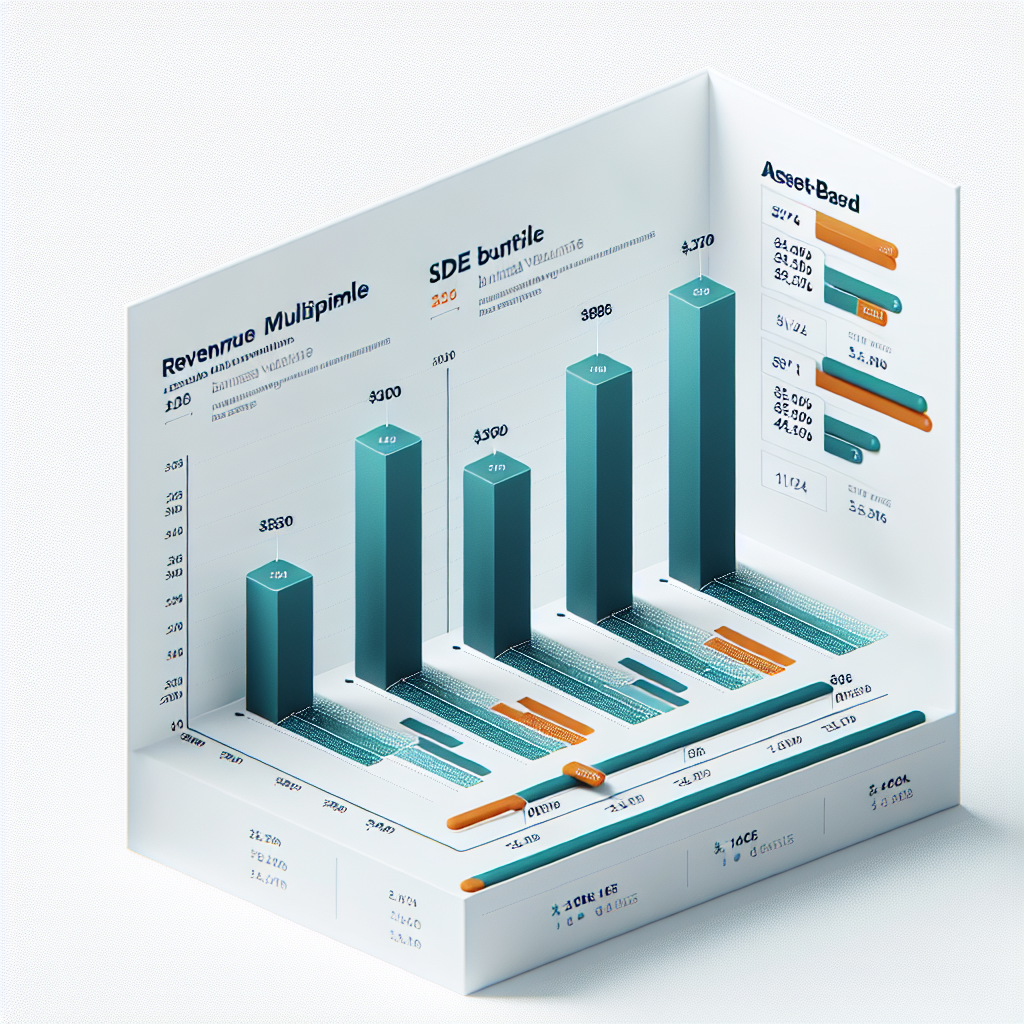
Revenue Multiple: You take the company's annual revenue and multiply it by a factor — typically somewhere between 0.4x and 0.8x for HVAC businesses. This is the laziest method and the one brokers love because it produces the biggest number. A company doing $2 million in revenue at a 0.6x multiple is "worth" $1.2 million. Simple, clean, and almost always misleading. Revenue tells you nothing about profitability. I've seen HVAC companies doing $3 million a year that lose money every single month. Revenue multiples are a starting point for conversation, not a basis for a purchase price.
SDE Multiple (Seller's Discretionary Earnings): This is the gold standard for businesses under $5 million in value. You calculate what the owner actually takes home — salary, perks, add-backs, all of it — and multiply by a factor. For HVAC, that factor typically ranges from 2.5x to 4x. This method rewards profitability over top-line growth, which is exactly what matters when you're the one writing the checks.
Asset-Based Valuation: You add up everything the company owns — trucks, tools, inventory, equipment, real estate — and subtract what it owes. This gives you the floor price: what the business is worth if you liquidated it tomorrow. For HVAC companies with a large fleet or valuable real estate, this number can be surprisingly high. For service-heavy companies with leased vehicles and rented office space, it's almost nothing.
| Method | Best For | Typical HVAC Range | Strengths | Weaknesses |
|---|---|---|---|---|
| Revenue Multiple | Quick screening; comparing similar-size companies | 0.4x – 0.8x annual revenue | Easy to calculate; widely understood by sellers | Ignores profitability entirely; can wildly overvalue unprofitable firms |
| SDE Multiple | Owner-operated businesses under $5M value | 2.5x – 4.0x SDE | Reflects actual cash flow to owner; accounts for add-backs | Requires accurate financial records; sensitive to add-back disputes |
| Asset-Based | Companies with significant hard assets (fleet, real estate, equipment) | Sum of fair-market-value assets minus liabilities | Sets a hard floor price; useful for distressed businesses | Ignores goodwill, customer relationships, recurring revenue |
Pro tip: Run all three methods on every deal. If the SDE multiple says $1.2M, the asset valuation says $800K, and the revenue multiple says $1.6M — you've got a realistic range of $800K to $1.2M. The revenue multiple number is the seller's fantasy; ignore it. The real negotiation happens between the SDE and asset numbers.
Now let's break down the method that matters most: SDE.
Seller's Discretionary Earnings: The Number That Matters
SDE stands for Seller's Discretionary Earnings, and it answers the simplest question in business valuation: how much money does the owner actually take out of this company? Not revenue. Not gross profit. The actual cash that ends up in the owner's pocket, both directly and indirectly.
Here's the basic formula:
SDE = Net Profit + Owner's Salary + Owner's Benefits + Interest + Depreciation + Amortization + One-Time / Non-Recurring Expenses + Personal Expenses Run Through the Business
That looks straightforward on paper. In practice, it's where every HVAC deal either comes together or falls apart, because the add-backs are where all the arguments happen.
Let me walk you through the HVAC-specific adjustments that most accountants miss:
Owner's salary and draws. Most HVAC company owners don't pay themselves a "salary" in the traditional sense. They take draws, pay themselves differently in different months, and sometimes don't take anything during slow periods. You need to reconstruct what the owner actually pulled out over the last three years, including distributions, draws, personal credit card charges, and auto-calculated payroll that might be listed under different line items each year.
Family members on payroll. The owner's wife handles the books part-time and draws $65,000 a year. Their son answers phones in the summer for $20/hour. Their brother-in-law has a truck and a toolbag but hasn't completed a service call since 2019. All of that gets added back to SDE — but only if you can replace those functions for less. If you actually need a full-time bookkeeper at $55,000, the add-back is only $10,000, not $65,000.
Vehicle perks. The owner drives a $75,000 truck that the company pays for, insures, fuels, and maintains. That's an add-back. But be careful: if you plan to drive a company vehicle too, you're just swapping one expense for another. The real add-back is the difference between what the owner spends and what you'd spend.
Personal expenses through the business. Cell phones, meals, travel, country club memberships, the "company retreat" that was actually a family vacation to Disney World. In HVAC companies under $3 million in revenue, it's common to find $30,000 to $80,000 in personal expenses buried in the books. These are legitimate add-backs, but you need documentation. A verbal "oh, about $50K in personal stuff" doesn't cut it.
One-time expenses. Did the company replace a roof last year? Settle a lawsuit? Buy a new phone system? Those are non-recurring costs that depressed net income in that specific year. They're valid add-backs, but you need to be honest about what's truly one-time. If the company has a "one-time" expense every single year, it's not one-time — it's a cost of doing business.
The add-back danger zone: Sellers will try to add back everything. "We spent $40K on marketing we didn't need." If you cut that marketing, will revenue drop? Then it's not an add-back. "We hired an extra tech we didn't need." Is that tech generating revenue? Then it's not an add-back. Every add-back should pass a simple test: if you remove this expense, does the business still produce the same revenue?
A Realistic SDE Checklist for HVAC
- Owner's total compensation (salary + draws + distributions) — reconstructed from bank statements, not just tax returns
- Owner's personal benefits (health insurance, retirement contributions, life insurance)
- Family member payroll above replacement cost
- Personal vehicle expenses above what you'd spend
- Personal cell phone, meals, travel, entertainment
- One-time legal, repair, or capital expenses (verified as truly non-recurring)
- Interest expense (removed because your financing will be different)
- Depreciation and amortization (non-cash charges)
- Rent above market rate if the owner also owns the building
- Any above-market payments to related parties (landlord brother, supplier cousin, etc.)
When you add it all up, the SDE for a healthy HVAC company doing $1.5 to $3 million in revenue is usually somewhere between $250,000 and $600,000. If the seller claims an SDE above 30% of revenue, that's possible — but verify every single line item. If they claim above 40%, something is wrong. Either they're inflating add-backs, underreporting expenses, or running the company so lean that it's about to break.
Revenue Multiples in HVAC: What the Market Actually Pays
Let's talk real numbers, because this is where the internet will lead you astray. You'll read articles claiming HVAC businesses sell for "3x to 6x earnings." That range is so wide it's useless. It's like saying a house costs between $150,000 and $900,000. Technically true, completely unhelpful.
Here's what actually happens in the market for HVAC businesses doing between $1 million and $5 million in revenue:
The typical range is 2.5x to 4.0x SDE. Not revenue — SDE. That distinction matters enormously. A company with $2 million in revenue and $300,000 in SDE at a 3x multiple is worth $900,000. The revenue multiple equivalent is 0.45x — far below what most sellers think their revenue is "worth."
What gets you to the high end (3.5x – 4.0x):
- Strong recurring revenue — maintenance contracts covering 500+ residential customers or 50+ commercial accounts
- Diversified customer base — no single customer represents more than 5% of revenue
- Modern fleet — average vehicle age under 4 years, average mileage under 60,000
- Clean financials — three years of CPA-prepared statements, not QuickBooks printouts
- Manager in place — the business runs without the owner on every job
- Growing market — the service area is gaining population, not losing it
- Licensed and bonded properly — all state and local licenses current, transferable
What drops you to the low end (2.5x – 3.0x):
- Owner-dependent — the owner is the lead tech, the sales closer, and the customer relationship
- Revenue concentration — one or two commercial accounts represent 30%+ of revenue
- Aging fleet — trucks with 100K+ miles that need replacement within 2 years
- Messy books — handwritten ledgers, mixed personal/business accounts, tax returns that don't match bank statements
- No service contracts — all revenue is one-time install or emergency repair
- Key person risk — one technician handles 40% of all service calls
"A 15-van fleet with 120K miles on every vehicle is not a $2M business. It's a $2M business minus $400K in trucks you're going to have to buy in the next 18 months. Do the math before the seller does it for you."
What about businesses above $5 million in revenue? Different ballgame. Once you cross $5 million, you start attracting private equity buyers and roll-up operators. Multiples can jump to 4.5x to 6x SDE because the buyer is building a platform, not buying a job. If you're a first-time buyer looking at a $5M+ company, you're competing against people with much deeper pockets and much lower return expectations. That's a fight you'll usually lose.
What about businesses under $1 million in revenue? Honestly, these barely have a "multiple." A one-truck operation doing $600K in revenue is really just selling a job and some equipment. The valuation floor is the asset value (truck, tools, inventory) plus maybe 1x to 1.5x SDE for the customer list and phone number. Don't overcomplicate it.
The 10% rule of thumb: For every major issue you uncover — aging fleet, owner dependency, customer concentration, messy books — knock 10% off the midpoint multiple. A business that would otherwise be worth 3.25x SDE drops to 2.95x with one issue, 2.65x with two, and so on. This isn't scientific, but it keeps you honest in negotiations.
The Seasonal Cash Flow Trap
This is the section that could save you from the single most common mistake first-time HVAC buyers make. Every HVAC company I've ever seen has the same basic cash flow pattern, and if you don't understand it before you buy, you will have a very bad first year.
Here's the pattern for a typical residential HVAC company in a four-season climate:
June through September: Money pours in. Air conditioning installations, emergency AC repairs, maintenance contract renewals. These four months typically generate 40% to 50% of annual revenue. Cash is flush. The business looks amazing. You feel like a genius for buying it.
October through November: The transition period. Heating system tune-ups bring in decent revenue, but it's a fraction of summer. Cash starts to tighten. This is when you realize you need to start managing payroll more carefully.
December through February: The desert. Unless you're in a cold climate where furnace emergencies keep the phones ringing, these are the months that break new owners. Revenue drops 60% to 70% from peak. You're still paying insurance, truck payments, rent, and technicians who are standing around waiting for calls. This is where your cash reserves get tested.
March through May: The slow climb back. AC tune-ups start, spring installations pick up, and you can finally breathe again. But you've been running on fumes for three months, and the credit line you swore you'd never touch is maxed out.
The trap: Sellers show you the annual P&L. It says $2.1 million in revenue and $340,000 in SDE. Looks great. What it doesn't show you is that $180,000 of that SDE was generated in four months, and the remaining eight months collectively produced $160,000 — barely enough to cover fixed costs. If you close the deal in October, you're walking into an eight-month cash drought with fresh debt service on top of existing expenses.
What smart buyers do:
Ask for monthly P&L statements for the last three years, not annual summaries. Map the cash flow by month. Identify the worst three-month stretch in each year and ask yourself: can I survive that on my reserves plus the credit line I've arranged?
Then add 20% to whatever you think your cash reserve needs to be. Every new HVAC owner underestimates the winter burn rate because they've never experienced it with their own money on the line.
Some HVAC companies mitigate seasonality better than others. Commercial-heavy businesses with maintenance contracts tend to have more consistent monthly revenue. Companies in warm climates have a different cycle — their slow period is winter, but it's less severe. Companies that offer both HVAC and plumbing have natural hedges. Factor this into your valuation: a company with proven seasonal mitigation is worth a higher multiple than one that rides the summer wave and white-knuckles through January.
"I tell every buyer the same thing: whatever the annual number is, divide it by twelve and ask yourself if you can survive on half that amount for four months straight. If the answer is no, you're not ready — or the deal isn't right."
Seasonal Adjustment Checklist
- Request monthly P&L statements (not annual) for the last 36 months
- Calculate revenue concentration — what percentage comes from the peak 4 months?
- Identify the worst consecutive 3-month cash flow period in each year
- Map monthly fixed costs (rent, insurance, loan payments, base payroll)
- Calculate the gap between worst-quarter revenue and fixed costs
- Add that gap (plus 20% buffer) to your required startup capital
- Factor seasonal stability into your valuation multiple — flatter is better
- Time your closing date strategically — closing before peak season gives you runway
Equipment Depreciation: The Hidden Value Destroyer
Here's where I've seen more first-time buyers get burned than anywhere else in the valuation process. The seller's balance sheet says the company has $450,000 in assets. The trucks, the tools, the recovery machines, the vacuum pumps, the brazing equipment, the inventory. It's all listed right there in black and white. And it's all wrong.
Book value is not market value. A truck that was purchased for $55,000 three years ago and has been depreciated to $22,000 on the books might be worth $30,000 at auction — or it might be worth $8,000 because it has 180,000 miles and a transmission that shudders going uphill. The books don't know. The books don't care. The books just run the depreciation schedule that the accountant set up on day one.
The HVAC-specific depreciation traps:
Trucks and vans. Service vehicles in HVAC take an absolute beating. Stop-and-go driving, heavy loads, idling for hours, tools rattling around in the back. A truck with "only" 90,000 miles on it might have the wear of a 150,000-mile highway vehicle. Don't trust the odometer alone. Look at maintenance records, check for frame rust, ask the techs which trucks they avoid.
Refrigerant recovery equipment. EPA regulations have changed refrigerant requirements multiple times. Equipment certified for R-22 recovery is nearly worthless now because R-22 is phased out. If the seller has $40,000 in recovery equipment on the books but half of it is R-22 spec, the real value is maybe $12,000.
Diagnostic and testing equipment. Technology moves fast. A combustion analyzer from 2018 might still work, but if it can't interface with modern smart thermostats and building automation systems, it's a paperweight. Manifold gauges, multimeters, and basic hand tools hold their value. Anything digital has a shelf life.
Parts inventory. This is the big one. HVAC companies tend to hoard parts. Walk into any HVAC shop and you'll find shelves of parts for equipment that hasn't been manufactured in a decade. The books might say $80,000 in inventory. The real value — parts you can actually install in systems that are still in service — might be $35,000. The rest is scrap metal and nostalgia.
The depreciation math that kills deals: If the balance sheet shows $450K in assets but the fair market value is $280K, that's a $170K gap. If you're paying based on an asset-inclusive valuation without adjusting for this gap, you're overpaying by $170K before you even start negotiating the business value. This is money you will have to spend replacing worn-out trucks and obsolete equipment in the first two years.
Equipment Valuation Checklist
- Get a complete vehicle list with year, make, model, mileage, and maintenance history
- Have an independent mechanic inspect every vehicle — not the seller's mechanic
- Inventory all refrigerant recovery equipment and verify EPA certifications are current
- Separate inventory into three categories: actively used, occasionally used, and obsolete
- Price-check equipment against current wholesale values, not book values
- Calculate the 24-month replacement cost for any asset over 70% of its useful life
- Subtract the replacement cost from any asset-based valuation
- Negotiate a holdback or escrow for equipment that's questionable but not clearly worthless
I can't stress this enough: bring someone who knows HVAC equipment to evaluate the assets. Your accountant can read a depreciation schedule. You need a person who can open a truck hood, listen to a compressor, and tell you whether that $30,000 book value is a $30,000 asset or a $3,000 problem.
Putting It All Together: A Sample HVAC Valuation
Let's run through a complete valuation so you can see how all of this works in practice. I'm going to use a fictional company, but every number in this example is based on real deals I've seen. This is what a thorough HVAC valuation actually looks like.
The company: Comfort Zone Heating & Air. Residential and light commercial HVAC in a mid-size Midwestern city. In business 22 years. Owner wants to retire. Twelve employees including the owner. Eight service trucks. Listed at $1.8 million.
Gather the Raw Financials
We request three years of tax returns, P&L statements, and balance sheets. Here's what we see:
- Year 1 revenue: $2.1M, net income: $95K
- Year 2 revenue: $2.3M, net income: $110K
- Year 3 revenue: $2.4M, net income: $125K
At first glance, the seller's $1.8M asking price looks aggressive for a company netting $110K on average. But we haven't done the add-backs yet.
Calculate Adjusted SDE
Using Year 3 (the most recent) as the baseline, here are the add-backs:
- Net income: $125,000
- Owner's salary and draws: +$135,000
- Owner's health insurance and retirement: +$22,000
- Owner's vehicle (personal use portion): +$14,000
- Wife's part-time bookkeeping salary (replacement cost: $30K, she earns $52K): +$22,000
- One-time roof repair: +$18,000
- Personal meals and entertainment: +$9,000
- Interest on existing debt: +$31,000
- Depreciation: +$62,000
Total Year 3 SDE: $438,000
We run the same calculation for Years 1 and 2 and get $385,000 and $412,000 respectively. The three-year weighted average (weighting the most recent year more heavily) comes to approximately $420,000.
Apply the SDE Multiple
Now we assess where this company falls on the multiple spectrum. Positives: 22 years in business, growing revenue, decent employee count. Negatives: the owner runs all commercial sales personally, the fleet averages 95,000 miles, and only 20% of revenue comes from service contracts.
This is a solid but owner-dependent company with an aging fleet and limited recurring revenue. That puts us at the lower-middle of the range: 2.8x to 3.2x SDE.
- Low estimate: $420,000 x 2.8 = $1,176,000
- Mid estimate: $420,000 x 3.0 = $1,260,000
- High estimate: $420,000 x 3.2 = $1,344,000
Run the Asset Check
The balance sheet lists $380,000 in assets. We do our independent assessment:
- Eight service trucks (book: $195K, fair market: $135K — three trucks need replacing within 18 months)
- Tools and equipment (book: $85K, fair market: $55K — some outdated recovery gear)
- Parts inventory (book: $72K, fair market: $45K — roughly $27K in obsolete stock)
- Office equipment and fixtures (book: $28K, fair market: $12K)
Adjusted asset value: $247,000 (vs. $380,000 on the books). The asset floor is well below the SDE-based valuation, which is normal for a service business. But the $133,000 gap tells us we need to budget for near-term capital expenditures.
Apply the Seasonal Adjustment
Monthly P&L review reveals that December through February averages $95,000/month in revenue against $140,000/month in fixed costs. That's a $45,000/month cash deficit for three months — a $135,000 winter hole we need reserves to cover.
This doesn't directly change the valuation, but it tells us we need $135,000 to $165,000 (with buffer) in working capital on top of the purchase price. If we can't finance that, the deal doesn't work at any price.
Factor in Capital Expenditures
Three trucks need replacing within 18 months. New service vans run $45,000 to $55,000 each. That's $135,000 to $165,000 in capital expenditure that the seller has deferred. This is money you'll spend that the seller didn't — it's a real cost of ownership that should influence your offer price.
We reduce our SDE-based range by approximately $50,000 to account for this (roughly one-third of the capex, reflecting the fact that you'd finance the trucks over time, not buy them outright).
Set the Offer Range
Putting it all together:
- SDE-based range: $1,176,000 – $1,344,000
- Capex adjustment: -$50,000
- Adjusted range: $1,126,000 – $1,294,000
- Asset floor: $247,000 (not a constraint here)
- Additional working capital needed: $135,000 – $165,000
The seller is asking $1.8 million. Our analysis says the business is worth $1.1M to $1.3M, and we need another $150K in working capital. We open at $1,100,000 with a clear, data-backed explanation of how we arrived at the number. We expect to land somewhere around $1.2 million, probably with some seller financing to bridge the gap.
The result: The seller originally wanted $1.8M. Our valuation showed a fair range of $1.1M to $1.3M. That's a $500K to $700K gap between perception and reality — and it's completely normal. This is why you do the work. If you'd paid asking price, you would have overpaid by roughly 40% and started your ownership buried in unnecessary debt.
Notice what this process didn't require: an MBA, a financial advisor charging $300/hour, or a magic spreadsheet. It required patience, access to the financial records, a mechanic to look at the trucks, and the willingness to sit down and do the math. Every number in this example came from publicly available market data and the seller's own books.
That's the entire secret to HVAC valuation: it's not complicated, but it is detailed. The buyers who take shortcuts — who trust the broker's number, who skip the asset inspection, who don't ask for monthly P&Ls — are the ones who overpay. The buyers who do this work are the ones who build generational wealth.
"The best deal I ever saw was the one the buyer was willing to walk away from. She did the valuation, made a fair offer $600K below asking, and the seller said no. Six months later he called back. They closed at her number."
Do the math. Trust the math. And don't let anyone — seller, broker, or your own excitement — talk you into paying a penny more than the math supports.