
Private equity has poured billions into HVAC since 2020, and add-on acquisitions jumped 88% year-over-year through mid-2025. If you're trying to buy a single shop, that changes the game — but not the way most people think. Here's what PE consolidation actually means for your deal, where independents still win, and how to compete without a $500M fund behind you.
You're browsing BizBuySell. You find a 20-tech HVAC company in a mid-size metro doing $4M in revenue. Solid maintenance agreement book, clean financials, owner wants to retire. You start running the numbers.
Then you find out a PE-backed platform already made an offer. They're paying cash. They can close in three weeks. And the multiple they're offering would make your SBA-funded bid look like a garage sale counteroffer.
This is happening more often. A lot more often. And if you don't understand why it's happening and where the gaps are, you'll either overpay for a business or give up on deals you should be winning.
Neither outcome is necessary.
The $10 Billion Question You Can't Ignore
Private equity discovered HVAC about a decade ago. They loved what they saw:
- Recurring revenue from maintenance agreements (a model the Air Conditioning Contractors of America has long championed)
- Recession-resistant demand (people need heat in January)
- Fragmented market with thousands of independent owners approaching retirement
- Predictable cash flow that makes debt financing easy
Since 2020, the pace has been staggering. According to PitchBook data, PE firms have deployed north of $10 billion into HVAC services. Add-on acquisitions — where a PE-backed platform buys smaller shops to bolt on — increased 88% year-over-year through mid-2025.
That's not a blip. That's a structural shift in who's buying HVAC businesses and how much they're willing to pay.
But here's where the narrative gets lazy. You'll read articles that say "PE is buying everything" or "independent operators are finished." Neither is true. PE firms are buying specific types of HVAC businesses at specific sizes for specific strategic reasons. Once you understand those reasons, you can see exactly where they're not looking — and where your opportunity lives.
How the Roll-Up Machine Actually Works
If you're going to compete with PE, you need to understand their playbook. It's not complicated, but it is ruthlessly logical.
Step 1: Buy the platform
A PE firm acquires a large, well-run HVAC company — typically $5–15M in revenue, $1–3M in SDE. This becomes the "platform." It has management infrastructure, brand recognition, systems, and enough scale to absorb smaller companies.
They'll pay a premium for this one. Often 5–7x SDE. Sometimes more. The platform is the foundation, and they'll overpay for the right one.
Step 2: Bolt on smaller shops
Once the platform is running, the PE firm goes shopping. They acquire 5–15 smaller HVAC companies over 3–5 years. These add-ons bring new geography, customer lists, technicians, and revenue.
The key: they buy these add-ons at lower multiples than they paid for the platform. A $600K SDE shop might sell for 3.5–4.5x as an add-on. That's the arbitrage.
Step 3: Integrate and professionalize
New scheduling software. Centralized dispatch. Unified branding (sometimes). Group purchasing for equipment. Standardized training. The add-ons get absorbed into the platform's infrastructure.
This is where the value creation actually happens. A fragmented collection of shops becomes one company with centralized operations and better margins.
Step 4: Sell the combined entity at a higher multiple
A $5M SDE platform built from eight acquisitions doesn't sell for 4x. It sells for 7–9x — sometimes higher. The PE firm bought the parts at 3.5–5x and sells the whole at 7–9x. That spread is where the money is.
The shops PE firms want as add-ons are the same shops you're looking at. Same size, same markets, same brokers. You're not competing with PE for Fortune 500 companies. You're competing for the 12-tech residential/commercial shop doing $2M in revenue that both of you think is a great business.
What PE Activity Does to Your Deal
Let's stop talking in abstractions and get to what this actually changes when you're trying to buy a specific HVAC company.
Valuation inflation
This is the big one. When sellers know PE firms are paying 4–5x SDE for add-on acquisitions, your offer at 3x looks insulting — even if 3x is the historically fair multiple for a business that size.
A shop doing $800K in SDE that would have sold for $2.4M five years ago now expects $3.2–4M. The seller's broker will tell them PE is paying those numbers. The broker is often right.
Your options: pay the inflated price (bad), find deals where PE isn't bidding (good), or offer non-price value that tips the scale in your favor (better — more on this below).
Talent competition
PE-backed platforms can offer technicians things you can't:
- Health insurance from day one
- 401(k) with match
- Signing bonuses of $3–5K for experienced techs
- Defined career paths (lead tech, supervisor, service manager)
- Company-paid training and certifications
Your 6-van shop? You're offering a handshake, a decent hourly rate, and the promise that "we're like family here." That's fine. But when a PE platform recruits three of your best techs with a $5K signing bonus and a benefits package, "like family" doesn't pay the orthodontist.
This affects you pre-acquisition too. If the shop you're buying has already lost its best techs to a PE platform, the value of what you're acquiring just dropped. Check turnover rates in due diligence. Ask specifically about departures to PE-backed competitors.
Vendor pricing gap
A 30-location PE platform buys 2,000 condensers a year from Carrier. You buy 80. Guess who gets better pricing.
The spread is real: 15–20% on major equipment, 10–15% on parts. That's margin you don't have. On a $15K residential install, the PE platform's equipment cost is $1,500–2,000 less than yours before the truck even rolls.
You can't fully close this gap. But you can narrow it through buying groups and distributor relationships. More on that in a minute.
Speed pressure
PE buyers move fast. They've done this 40 times. Their LOI is templated. Their due diligence team has a checklist. Their lawyers have the APA drafted before the seller finishes their second cup of coffee.
You? You're getting SBA pre-qualified, finding a lawyer who understands asset purchases, and trying to figure out what a quality of earnings report is. That 60–90 day SBA loan timeline looks like a geological era next to a PE buyer who can close in 21 days with cash.
Speed doesn't always win. But when a seller is motivated and two offers are close, the one that closes next month beats the one that closes next quarter.
Where Independent Buyers Still Win
Here's the part nobody writes about because it doesn't fit the "PE is eating everything" narrative. There are real, structural advantages to being an independent buyer. PE firms know about them. They just can't fix them.
Deals PE doesn't want
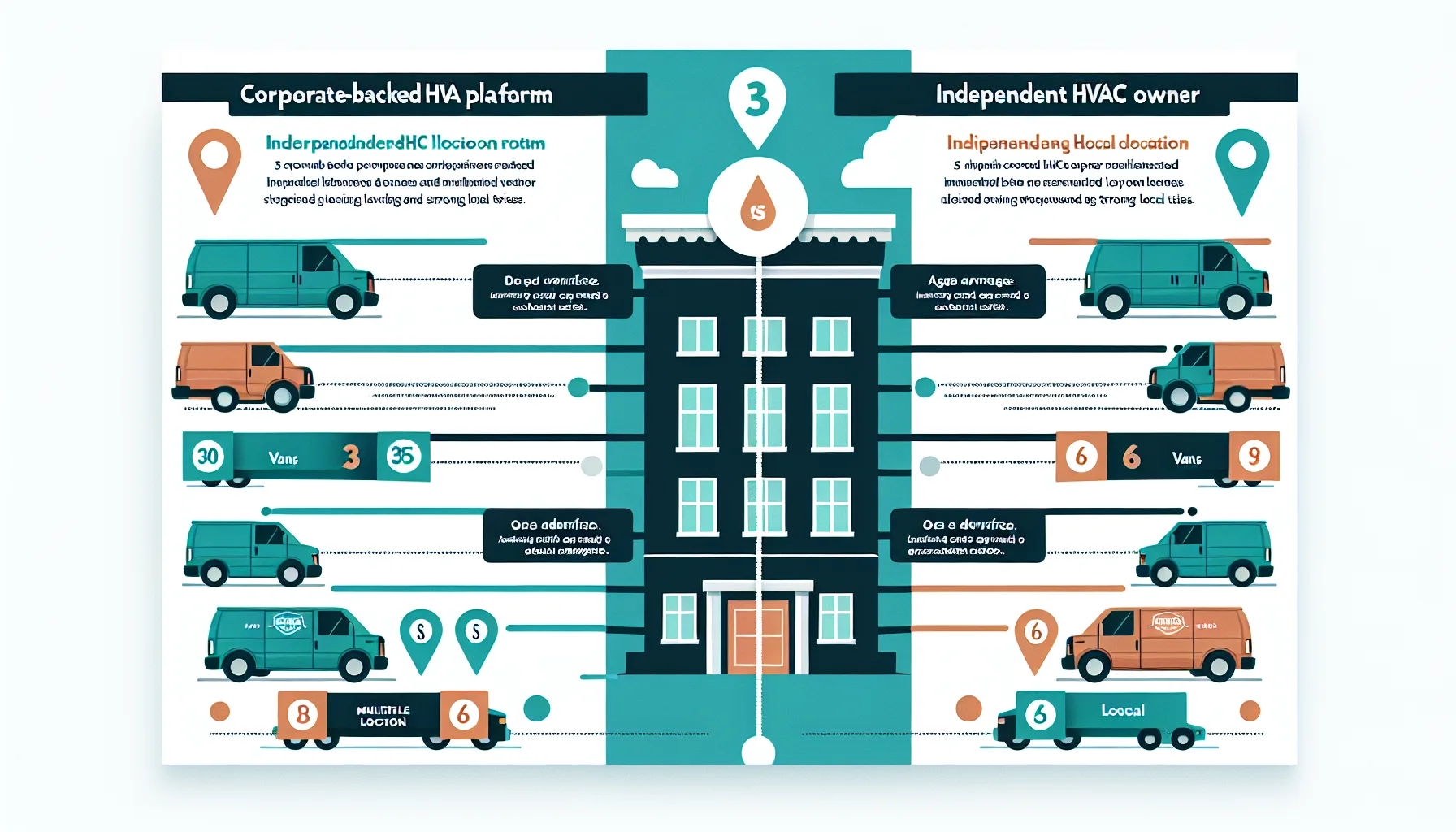
PE add-on math requires a minimum threshold to make sense. The legal, accounting, and integration costs of an acquisition are roughly the same whether you're buying a $300K SDE shop or a $1.5M SDE shop. So PE firms skip the small ones. That's why PE can't reach sub-$3M deals — the economics simply don't justify the overhead for them, leaving thousands of retiring-owner shops available to independent buyers.
The sweet spot for independent buyers: shops doing $250K–$750K in SDE. One location. Under 15 employees. Maybe the owner still runs service calls. PE looks at these and sees too much work for too little scale. You should look at these and see your future.
A 6-tech residential shop doing $1.2M in revenue and $400K in SDE? PE doesn't want it. But at 3–3.5x, that's a $1.2–1.4M acquisition you can finance with an SBA 7(a) loan, a 10% equity injection, and maybe a seller note for the gap. The cash flow covers the debt service. You're profitable from month one.
Seller preference
This one is massive and underappreciated.
The guy who built an HVAC company from a single van in 1992 doesn't always want to sell to a private equity firm from Connecticut. He's watched what happened when his buddy sold to a platform — new name on the trucks in six months, half the crew replaced within a year, his buddy gone in 90 days with an NDA and a check.
Many sellers — especially those with long-tenured employees — will take a lower price to sell to someone who'll:
- Keep the company name
- Retain the crew
- Stay in the community
- Actually run the business instead of managing it from a spreadsheet
I've seen sellers take 15–20% less to sell to a former employee or a local operator instead of PE. That's not sentiment — that's a real pricing advantage you have if you show up the right way.
Local relationships matter more than you think
PE platforms churn through management. The regional manager covering your market has six other locations to worry about and a quarterly revenue target breathing down their neck. They're not showing up at the Rotary Club. They're not coaching Little League with the facilities director at the local school district.
You are.
Commercial and municipal accounts are relationship businesses. The property manager who's used the same HVAC company for 12 years doesn't want to call a 1-800 number. When you're the owner and you answer the phone, that's a competitive advantage no PE platform can replicate at scale.
Speed and simplicity (on the operations side)
No board meetings to approve a $30K equipment purchase. No regional VP who needs to sign off on a new hire. No six-month rebranding initiative. No integration playbook.
You buy it. You run it. You make decisions at the speed of a phone call.
That operational agility is worth real money in a service business where the customer's furnace died at 9 p.m. on a Friday. The PE platform's after-hours call goes to a dispatch center in Phoenix. Yours goes to you, and you send your best tech.
How to Compete for a Deal When PE Is Also Looking
Alright, practical stuff. You're looking at a business and you hear PE might be interested. Here's your playbook.

Target the right size
Stay under $1M SDE. Ideally $300K–$750K. The add-on acquisition math doesn't pencil for most PE platforms at this size. You're not competing with them — you're fishing in a different pond.
Lead with relationship
Meet the seller before you submit an offer. Tour the shop. Ask about their employees. Ask what they're worried about. Most PE firms send a junior associate to do a site visit after the LOI is signed. You show up first, in person, and demonstrate that you know what a recovery charge looks like.
Sellers in this industry are tradespeople. They respect people who understand the work.
Offer transition support
PE platforms typically want the seller out in 60–90 days. They have their own management. Your offer should include 6–12 months of transition overlap. The seller stays on as a consultant, introduces you to key accounts, transfers the relationships.
This costs you money (usually $5–10K/month for the seller's time). It's the best money you'll spend. And it's something PE can't easily offer because their integration playbook doesn't have a line item for "let the old owner hang around."
Use seller financing strategically
Your total purchase price might be lower than PE's offer. But your terms can be more attractive.
Seller carries 15–20% of the purchase price as a note. That gives them ongoing income (often at a better rate than their money market account), tax advantages through an installment sale, and continued alignment with the business's success.
A $1.2M offer with $200K in seller financing at 7% over five years can beat a $1.35M all-cash PE offer if the seller values tax deferral and ongoing income. Structure the deal to fit the seller's retirement plan, not just your balance sheet.
Get SBA pre-qualified before you start looking
This is non-negotiable. The biggest knock on independent buyers is speed. Close the gap before it becomes an issue.
Talk to an SBA preferred lender. Get pre-qualified for a specific loan range. When you make an offer, include the pre-qualification letter. It tells the seller you're serious and funded — not some guy with a dream and a 640 credit score.
Pre-qualification takes 2–3 weeks. Do it first. Everything else gets easier.
The PE Advantage You Can Actually Copy
PE firms aren't successful just because they have money. They're successful because they professionalize the businesses they buy. You can do the same things. Most of them cost more time than money.
Build SOPs for everything
Standard operating procedures for installations, service calls, maintenance visits, customer callbacks. If a process lives in someone's head, it dies when that person leaves. Write it down.
PE firms obsess over this because it's what makes a business scalable. You should obsess over it because it's what makes a business sellable — and in the meantime, it just makes you a better operator.
Invest in scheduling and CRM software
ServiceTitan, Housecall Pro, Jobber — pick one and actually use it. Track every lead, every job, every callback. PE platforms run on data. You can too.
The cost is $200–500/month. The ROI is immediate: fewer missed appointments, better route optimization, faster invoicing, and real visibility into which techs are productive and which ones are taking two-hour lunches.
Build your maintenance agreement book
This is the single highest-leverage thing you can do to increase your company's value. Maintenance agreements are recurring revenue. Recurring revenue commands higher multiples at exit. Every PE firm in HVAC is building this same machine.
A business doing $2M in revenue with $400K from maintenance agreements is worth significantly more than the same $2M business with zero recurring revenue. Shoot for 20–30% of revenue from agreements within three years of acquisition.
Reduce owner-dependency
If the business can't function without you running service calls, approving every invoice, and handling every angry customer, you don't own a business — you own a job. PE firms specifically look for (or create) businesses where the owner can step away for a month and revenue doesn't flinch.
Hire a service manager. Delegate dispatching. Train someone to handle customer escalations. The goal: your business runs the same whether you're there or in Cabo.
This is also the single biggest value driver at exit. A buyer — PE or otherwise — pays more for a business that doesn't depend on the seller's personal relationships and daily presence.
Frequently Asked Questions
Should I be worried about PE buying the business I'm looking at?
If the business does over $1M in SDE and is in a metro with existing PE platform activity, yes — you should expect PE interest. Below $750K SDE, the risk drops significantly. PE add-on economics don't justify the integration costs for smaller shops. Either way, "worried" is the wrong frame. Informed is better. Know what PE values, target the deals they skip, and compete on terms they can't offer.
Is PE making HVAC businesses too expensive for individual buyers?
In some segments, yes. A $2M+ SDE business in a top-30 metro is going to trade at 5–6x whether you like it or not. That's PE pricing, and you probably can't (and shouldn't) match it. But the vast majority of HVAC businesses in the U.S. are under $1M in SDE. There are thousands of them. Most will never see a PE offer. These businesses are still trading at 2.5–4x SDE, and the owners are still retiring every day. The market is bigger than the PE headlines suggest.
Can I compete with a PE-backed offer?
On price alone? Usually not. On total value to the seller? Absolutely. Seller financing, transition support, keeping the company name, retaining the crew — these are real advantages. Not every seller optimizes for highest price. Many optimize for legacy, tax efficiency, and peace of mind. That's where you compete.
What if PE buys my competitor after I buy my shop?
This actually happens, and it's not necessarily bad. PE platforms that enter your market will spend heavily on marketing and recruiting, which raises general awareness of HVAC services. They also tend to raise prices, which gives you room to be the "affordable local option." The risk: they recruit your techs. The defense: pay fairly, treat your people well, and build a culture that makes staying worth more than a signing bonus. PE platforms often struggle with customer retention in markets where relationships matter — their Net Promoter Scores tend to drop 12–18 months post-acquisition as the service experience becomes more standardized and less personal. That churn is your gain.
PE consolidation in HVAC is real, it's accelerating, and pretending it doesn't affect your deal is foolish. But "PE is buying everything" is a lazy narrative that ignores the thousands of HVAC businesses PE will never touch. Your job as an independent buyer is simple: understand where PE plays, avoid competing head-to-head on their turf, and leverage the advantages they structurally cannot match — relationships, flexibility, speed of decision-making, and the simple fact that a retiring owner often trusts a fellow tradesperson more than a spreadsheet jockey from a fund. The shops PE skips are still good businesses. Often great ones. They're just not the right size or shape for a roll-up strategy. For you, buying one of them, running it well, and professionalizing the operations? That's not a consolation prize. That's the play.