

That HVAC business you’re looking at might be worth $500,000 more — or less — than the asking price. The answer is sitting in the revenue split between residential and commercial customers.
You found a business. Revenue looks good. The trucks are relatively recent. Owner’s been at it for 22 years and wants out. You’re looking at the P&L and trying to figure out whether this thing is worth what they’re asking.
Here’s the first question you should ask — before you look at any other number: What percentage of revenue comes from commercial customers?
Most buyers skip this question. They focus on SDE, they look at year-over-year revenue growth, they count the service vehicles. The customer mix feels like a detail. It’s not a detail. It’s the valuation.
A business with 40% commercial revenue doesn’t just look different from one that’s 95% residential. It prices differently. Lenders underwrite it differently. It behaves differently when you own it. And the gap in what you pay — on a $5 million deal — can easily run $500,000 to $750,000.
This is the article I wish someone had handed me before I started looking at acquisition targets.
Why the Residential/Commercial Split Is the First Number You Ask For
The split tells you what kind of business you’re actually buying before you read a single other document.
Here’s the short version of why it matters so much to valuation:
- Commercial revenue skews toward recurring maintenance contracts — the same kind of predictable, contractual revenue that raises SDE multiples.
- Commercial clients are stickier. A property manager doesn’t switch HVAC contractors because someone mailed a better coupon. Residential homeowners absolutely do.
- Commercial revenue tends to be larger per customer, which means less customer concentration risk across a similar total revenue number.
- PE platforms and sophisticated buyers are paying premium multiples for commercial-heavy books right now. Hyde Park Capital’s Q1 2026 market report flagged commercial HVAC services as the leading sector in active M&A. When the competition for a certain type of business heats up, prices follow.
The rule of thumb in the market: every 10 percentage points of commercial revenue, above a roughly 20% baseline, tends to improve the SDE multiple. The jump from 20% commercial to 40%+ commercial can represent 0.5x to 1.0x on the multiple.
On a business doing $500K in SDE at a 3.5x multiple, that’s a $1.75M deal. Shift that multiple to 4.5x and you’re at $2.25M. Same business. Different mix.
That’s why you ask about it first.
What “Commercial” Actually Means in HVAC (It’s Not One Thing)
Before you start mentally adding up the commercial percentage on a target, you need to understand that “commercial” covers a wide range — and not all of it is equal.
Light commercial
This is the sweet spot for most independent HVAC operators and the most common form of commercial revenue you’ll encounter in small-to-mid-size acquisitions.
Light commercial means: restaurants, small retail, strip malls, medical offices, dental practices, small office buildings, churches. These clients typically have rooftop package units, split systems, or light ductless systems. A tech who’s been doing solid residential work can usually navigate light commercial with some training.
Revenue profile: $500 to $3,000 per year on a maintenance contract. Emergency calls billed at commercial rates (typically 1.3x to 1.5x residential labor rates). Installations can run $5,000 to $40,000 depending on system count and scope.
Mid-commercial
Hotels, larger office buildings, multi-tenant retail, schools, government buildings. These facilities may have chillers, cooling towers, complex building automation systems (BAS), or large commercial rooftop units with more demanding service requirements.
Revenue profile: $2,000 to $15,000+ per year on maintenance agreements. Requires technicians with commercial certifications and hands-on experience with the equipment type. Installations in the six figures.
Industrial / heavy commercial
Manufacturing plants, data centers, hospitals, large institutional buildings. Generally not what you’ll find in a small HVAC acquisition unless the seller built the business specifically around it.
Not relevant to most buyers reading this. If you’re looking at an industrial HVAC business, you’re in a different conversation entirely.
What to look for in a target
The best acquisition target for a first-time buyer has its commercial revenue concentrated in light commercial — ideally with multi-year maintenance contracts. You want the recurring revenue without the specialized labor dependency that comes with complex mechanical systems.
Ask the seller: “When you say commercial, what types of buildings are we talking about? Can you break down the commercial revenue by customer type?”
How Residential and Commercial Revenue Behave Differently
This is where buyers underestimate the operational impact of the mix. Residential and commercial HVAC aren’t just different customer types — they’re fundamentally different businesses layered inside the same company.
Margins
Residential demand work: Thin to moderate. High customer acquisition cost (Google Local Services Ads aren’t free), shorter average ticket, competitive pricing in most markets. Maintenance plans run 40-55% gross margin when priced correctly.
Commercial maintenance contracts: Typically 45-60% gross margin on recurring visits, higher on emergency work because the commercial rate card is harder for clients to comparison-shop. A property manager isn’t Googling “HVAC repair near me” at 3pm on a Tuesday.
Commercial installations: Variable, but typically higher margin per job than residential, especially if the company has established relationships with general contractors or property managers who don’t bid every project.
Seasonality
Residential HVAC cash flow follows the weather. Hot climates surge in summer, mixed climates surge twice (peak cooling in summer, peak heating in winter), mild climates struggle with both. The demand work feast/famine cycle is a real operational challenge and a financing headache.
Commercial maintenance contracts flatten that curve. If 40% of your revenue is from commercial maintenance agreements with scheduled quarterly visits, you’re sending trucks in February not because anyone’s AC broke but because the contract says so. That predictability is worth something — both to you operationally and to the SBA lender who wants to know your debt service coverage in slow months.
Sales cycles
Residential sales cycle: homeowner calls, tech goes out, estimate gets done, decision happens within 48-72 hours for repairs, 1-2 weeks for replacements. Fast, transactional, high volume.
Commercial sales cycle: property manager issues a bid, you respond, they evaluate three to five competitors, procurement takes 30-90 days, contracts need to be reviewed by legal, payment terms are net-30 or net-60. Slow, relational, lower volume.
When you acquire a commercial book, you’re acquiring the results of relationships that took years to build. That’s the moat. It’s also a liability if those relationships live in the seller’s head rather than in a documented CRM. The same risk applies to the commercial estimating capability as key-person risk — if one person prices every bid, their departure kills the pipeline.
Customer concentration
A residential HVAC company with 2,000 customers and its top customer representing 0.1% of revenue is a beautifully diversified book. Lose 50 customers — you probably won’t even notice.
A commercial HVAC company with 12 clients and one property management company representing 35% of revenue is a different risk profile entirely. If that PM company gets bought out, changes vendors, or doesn’t like the new ownership — you’ve got a problem.
Neither profile is automatically bad. But you need to understand which one you’re buying.
The Valuation Math: How Mix Affects Multiples With Real Numbers
Let’s run this concretely, because “it affects the multiple” doesn’t mean much without numbers.
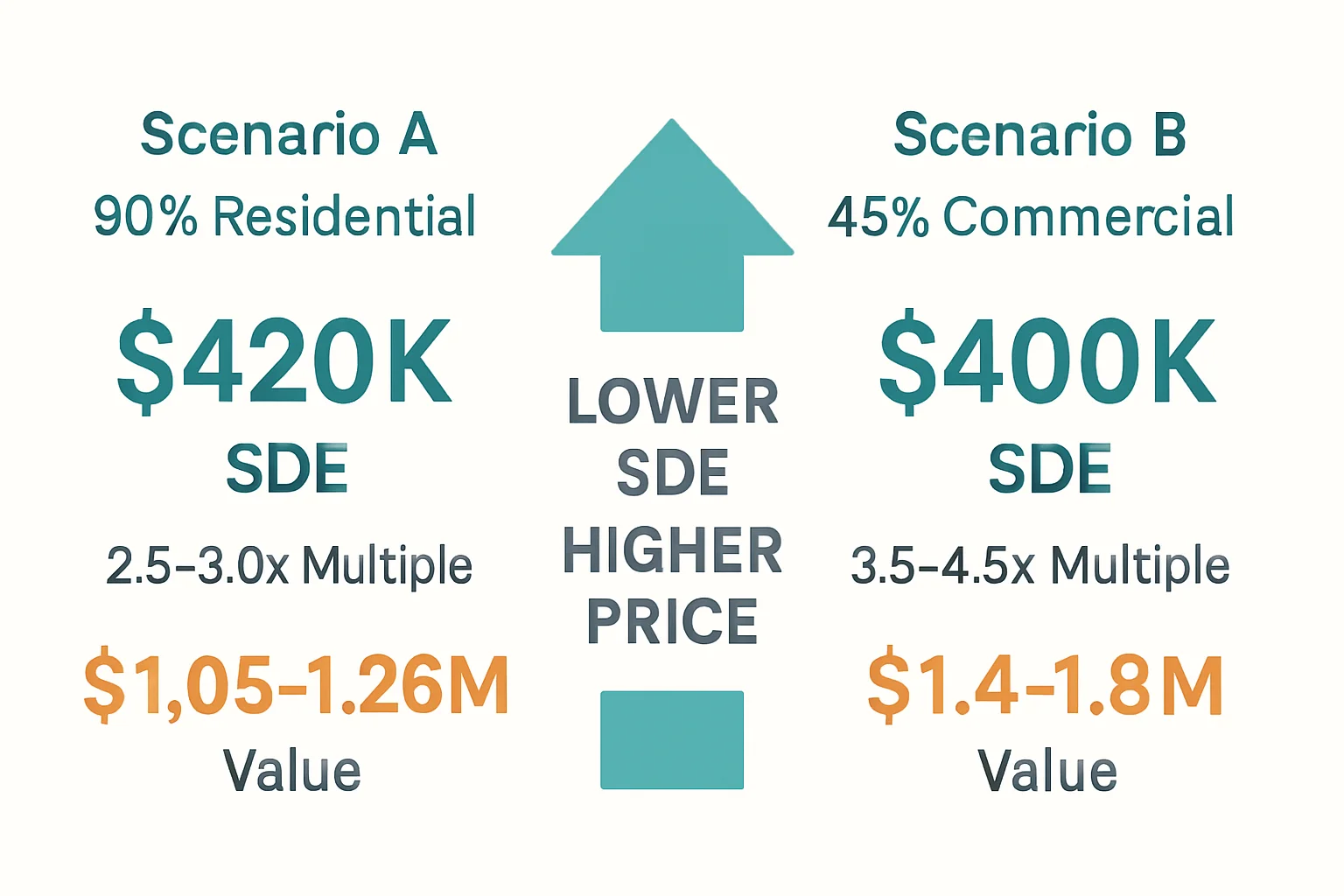
Scenario A: Residential-dominant shop
- Annual revenue: $2.1M
- SDE: $420,000
- Revenue mix: 90% residential demand work, 10% commercial
- No recurring maintenance contract program to speak of
- Market SDE multiple: 2.5x to 3.0x
- Valuation range: $1.05M to $1.26M
Scenario B: Mixed shop, strong commercial base
- Annual revenue: $2.0M (slightly lower total revenue)
- SDE: $400,000 (slightly lower SDE)
- Revenue mix: 55% residential, 45% commercial (majority on multi-year maintenance contracts)
- Churn on commercial agreements: under 12%
- Market SDE multiple: 3.5x to 4.5x
- Valuation range: $1.4M to $1.8M
Scenario B generates less revenue and less SDE. It sells for more money.
The reason: the buyer is purchasing a different quality of earnings. The commercial maintenance contract revenue is predictable, contractual, and likely to continue. The residential demand work in Scenario A is not. The market — and your SBA lender — prices that difference.
The 40% threshold
The industry benchmark you’ll hear from brokers and advisors: hitting 40%+ commercial revenue is the threshold for a meaningfully better multiple. Below 20% commercial, you’re in residential-only territory. Between 20-40%, you’re in transition — the market recognizes the commercial presence but doesn’t fully price it in.
Getting from 35% to 42% commercial can be worth more in valuation than a $50K increase in SDE. That’s a counterintuitive but real dynamic in this market.
Due Diligence: How to Evaluate a Target’s Customer Mix
The seller will tell you the revenue split. Your job is to verify it and stress-test it.
Step 1: Get the customer-level revenue report
Ask for a report showing every customer, their revenue for the trailing 12 months, their revenue for the prior 12 months, and whether they are residential or commercial.
This report should come out of whatever service software they’re using — ServiceTitan, Housecall Pro, FieldEdge, Successware, whatever. If they can’t produce this report, that’s a data management red flag, not an excuse to trust the summary numbers.
Step 2: Check concentration
Sort that report by revenue, largest to smallest. What does the top 10 represent as a percentage of total? What does the top customer represent?
Guideline: No single customer should represent more than 15% of revenue. If a commercial client represents 25%+, that relationship risk needs to be priced into your offer and addressed in your transition plan.
Step 3: Verify the commercial contract quality
For every commercial maintenance agreement, you want to know:
- Contract start date and term length
- Auto-renewal clause (yes or no)
- Assignment clause — does it require client consent to transfer to a new owner?
- SLA requirements — what response times are guaranteed, and can you deliver them?
- Pricing — when was it last updated, and is it at or below market?
Pull 10-15 sample contracts and read them. Not the summary. The actual documents.
Step 4: Identify relationship depth
This is the one that doesn’t fit in a spreadsheet. Commercial accounts are often held together by personal relationships — between the owner or a senior tech and the property manager.
Ask the seller: “If you weren’t involved anymore, would any of these commercial clients leave?”
Watch how they answer. If they say “oh no, they love the company” without hesitation, dig deeper. If they say “yeah, Johnson Properties has been my personal account for fifteen years, but he’s a fair guy,” you’ve just identified a transition risk you need to manage specifically.
Step 5: Look at the commercial pipeline
Is the company adding commercial clients, staying flat, or losing them?
A business that had 22 commercial clients three years ago and has 19 today has been losing ground. That’s not disqualifying, but it’s a trend you’d want to understand and a number that affects your acquisition math.
Post-Acquisition: Should You Shift the Mix?
You’ve bought a business. Maybe it’s 80% residential and you want to push toward that 40% commercial threshold to build equity value before you eventually sell. Here’s what’s actually involved.
The case for growing commercial
Higher margins on contracts, stickier clients, better cash flow predictability, significantly higher exit multiple when you eventually sell. If you’re thinking about a 5-7 year hold before your own exit, growing commercial from 20% to 40%+ could be worth more than almost anything else you do operationally.
The sales motion is completely different
Commercial clients don’t come through Google Ads. They come through relationships — with property managers, facility managers, general contractors, building owners. You or someone on your team needs to be building those relationships systematically. That means attending the local BOMA (Building Owners and Managers Association) meetings. It means connecting with GCs who do tenant improvement work. It means hiring a commercial sales rep with an existing book of property management relationships.
This is a grind. It takes 12-24 months to meaningfully shift the mix, even if you’re executing well.
You can’t charge commercial rates without commercial service capability
If you’re going to pursue commercial contracts, make sure you can deliver what commercial clients expect:
- Faster response times (often 4-8 hours for HVAC failure in occupied commercial space)
- Service across a wider range of system types and brands
- Documentation: commercial clients want service reports, not just a work order slip
- After-hours coverage: commercial buildings don’t care that it’s Sunday night
- Insurance and bonding appropriate for commercial work
Before you pitch your first property manager, make sure your shop can actually handle it.
The Crew Reality: Residential Techs Can’t Just Start Doing Commercial
This section could save you from a very expensive mistake.
The instinct when you’re building commercial revenue is to think: I’ll just send my residential techs on commercial calls. My guys are sharp. They’ll figure it out.
They probably won’t. At least not quickly, and not without problems.
Why residential and commercial skills don’t transfer automatically
A residential tech spends most of their time on 2-5 ton split systems and heat pumps. They know those systems cold. They are probably very good at diagnosing a failing capacitor on a Carrier 4-ton, or identifying a refrigerant leak in a residential evaporator coil.
A commercial rooftop package unit — the kind you find on a strip mall or office building — is a different animal. The service sequence is different. The controls can be different. The safety protocols are different. And that’s still light commercial. Move into chillers or VAV systems and you’re in a completely different world.
Sending an unprepared residential tech to a commercial call doesn’t just mean the call goes poorly. It means you damage the relationship with a client worth $4,000 a year. It means potential liability if the repair is done incorrectly on a building’s primary HVAC system. It means a callback that costs more than the job.
What you actually need
If you’re acquiring a business with existing commercial accounts, make sure the commercial service knowledge stays. Ask which techs currently handle the commercial accounts. Are those techs staying post-sale? If the two guys who handle all the commercial work are also the two who are closest to the seller personally — that’s a transition risk.
If you’re building commercial capability organically after acquisition, hire a commercially experienced lead tech first. Give them the commercial accounts as their primary responsibility. Let the residential techs watch and learn over time. Don’t force the cross-training by sending someone in cold.
Licensing considerations
Commercial work sometimes requires different licensing than residential — not always, but depending on your state and the system type. Verify before you pitch commercial clients that your license covers the work scope. This is especially relevant for refrigeration, high-voltage work, or boiler systems.
Frequently Asked Questions
How does residential vs. commercial mix affect HVAC business valuation?
Customer mix is one of the largest single factors in determining an HVAC company’s SDE multiple. Businesses with 40%+ commercial revenue — especially commercial maintenance contracts — typically command 0.5x to 1.0x higher multiples than comparable businesses with minimal commercial revenue. On a $5M deal, that’s a $500K to $1M valuation difference.
What percentage of commercial revenue is ideal for an HVAC acquisition?
The industry benchmark is 40%+ commercial revenue for a premium multiple. Above 60% commercial creates its own complexity around labor requirements and customer concentration. For most buyers, a target with 35-50% commercial — weighted toward light commercial maintenance contracts — is the sweet spot.
What is light commercial HVAC?
Light commercial refers to HVAC service for small to mid-size commercial buildings: restaurants, retail stores, strip malls, small office buildings, medical offices, and similar facilities. These typically use rooftop package units or split systems that are similar in technology to residential equipment. Light commercial work is manageable for experienced residential techs with some additional training.
How do you evaluate commercial customer concentration risk in an HVAC acquisition?
Request a customer-level revenue report from the trailing 12 months. Sort by revenue. If any single commercial client represents more than 15% of total revenue, that’s a concentration risk that needs to be priced into your offer and managed in your transition plan. Verify whether those relationships are contractual (safer) or personal-relationship-based (riskier).
Can residential HVAC technicians do commercial work?
Not automatically, and not without training. Residential techs are proficient with residential split systems and heat pumps. Commercial rooftop package units, chillers, VAV systems, and complex building automation systems require different skills and experience. Putting a residential-trained tech on a commercial call without preparation risks poor service, equipment damage, and losing a valuable client.
Should I try to shift a residential-heavy HVAC company toward commercial after acquisition?
Yes, if you’re planning a 5-7 year hold before exit — growing commercial from 20% to 40%+ can meaningfully increase your eventual sale multiple. But it takes 12-24 months of deliberate relationship-building, potentially hiring a commercial sales rep, and making sure your crew can actually deliver commercial-grade service before you start pitching commercial clients.
Do commercial HVAC contracts transfer automatically when a business is sold?
Not always. Residential agreements typically transfer without issue. Many commercial contracts include assignment clauses that require client notification or explicit consent before the contract can be transferred to a new owner. Read every commercial contract in the due diligence process and flag any that require client approval. These clients need personal outreach early in your transition plan.
What’s the difference between SDE and revenue in HVAC business valuation?
SDE stands for Seller’s Discretionary Earnings — it’s essentially the total economic benefit a working owner gets from the business each year. It includes net income plus the owner’s salary, owner’s benefits, and add-backs for one-time or non-recurring expenses. SDE is the number that HVAC businesses are valued against (e.g., “3.5x SDE”), not revenue. A business doing $2M in revenue might have $350K in SDE — and that $350K is what the multiple gets applied to.
The revenue split between residential and commercial isn’t a curiosity. It’s the architecture of the business you’re buying. A residential-heavy book is high volume, weather-dependent, and harder to predict. A commercial-balanced book is slower, stickier, and worth more money — both to lenders and to the next buyer when it’s your turn to sell.
Do the work during due diligence. Get the customer-level report. Read the commercial contracts. Understand which relationships are contractual and which ones leave when the owner does. The HVAC business you want to buy isn’t just the one with the best revenue number. It’s the one where the revenue is the most durable. That’s a different question — and most buyers never think to ask it.