

You’re looking at a $1.2 million HVAC company. Revenue is strong, SDE is clean, and the owner says it practically runs itself. Then you pull the customer breakdown and see that one commercial builder accounts for 38% of total revenue. Everything just changed.
You found what looks like a great deal. The financials check out, the trucks aren’t falling apart, and the techs seem happy. But buried in the revenue data is a number that should make you pause — or walk.
Customer concentration is one of the top three valuation discount factors in HVAC acquisitions. And unlike a tired fleet or messy books, you can’t fix it with money after closing. If that one big customer leaves, they take their revenue with them. Your loan payments don’t shrink to match.
Most of the advice out there is aimed at sellers: “diversify your customer base before you list.” That’s nice for them. This article is for you — the buyer. How to spot it, how to price it, how to negotiate around it, and how to decide whether the deal still works.
The Builder Who Made This Business — And Could Break It
Here’s the scenario. You’re evaluating a commercial HVAC company with $1.6M in annual revenue and $320K in SDE. Solid numbers. The owner has been running it for 18 years, and his biggest customer is a regional builder named — let’s call them Apex Development.
Apex has been sending this company new construction installs and service calls since 2014. They account for $608,000 in annual revenue. That’s 38%.
The owner talks about Apex like a partner. “We’ve been working together for over a decade. They love us. They’re not going anywhere.” He genuinely believes this. He’s probably right — as long as he’s the one answering the phone.
But you’re not buying his relationships. You’re buying a company. And when you’re the new name on the business cards, Apex doesn’t owe you a thing.
This is the most common hidden risk in HVAC deals, especially on the commercial side. Residential-heavy companies rarely have this problem — when your revenue comes from 800 homeowners calling for furnace repairs, no single customer moves the needle. But commercial HVAC businesses live and die by a handful of big accounts. Property managers, builders, facility management companies, school districts.
Warning: The owner sees their biggest customer as their best relationship. You should see it as your biggest liability. These two perspectives are not compatible at the negotiating table, and you need to be the one who’s right.
The psychology here matters. Sellers don’t hide concentration because they’re dishonest. They hide it because they don’t see it as a problem. To them, Apex is proof the business works. To you, Apex is a single point of failure that could vaporize a third of your revenue on 30 days’ notice.
What “Customer Concentration” Actually Means in HVAC
Customer concentration is simple: any single customer — or small group of related customers — represents a disproportionate share of revenue. In HVAC, this shows up in predictable patterns.
The Usual Suspects
- Commercial builders. One general contractor feeding you all your new construction work. This is the most common and most dangerous form because construction volume is cyclical. When the builder slows down, you slow down.
- Property management companies. A single PM company managing 200 units and sending you all the maintenance calls. Great recurring revenue — until they switch to an in-house team or get acquired by a company with their own vendor list.
- Government and institutional contracts. School districts, municipal buildings, county facilities. Stable until they rebid. And they will rebid.
- Large HOAs or condo associations. One relationship, dozens of units. High concentration disguised as “lots of customers.”
- One developer with multiple LLCs. This is the sneaky one. You see five different customer names in the books, but they’re all entities owned by the same person. One relationship. One decision-maker. One risk.
The Threshold Ladder
Not all concentration is equal. Here’s how it breaks down in practice:
- Under 15% from any single customer: Healthy. This is what a well-diversified HVAC business looks like. No discount needed.
- 15–25% from a single customer: Notable. Worth investigating, but not necessarily a dealbreaker. You’ll want to understand the relationship depth and contractual protections.
- 25–40% from a single customer: Serious discount territory. This materially affects valuation. If you’re proceeding, you need structural protections in the deal.
- Over 40% from a single customer: Walk-away territory for most buyers. At this level, you’re not buying a business — you’re buying a subcontractor relationship with extra steps.
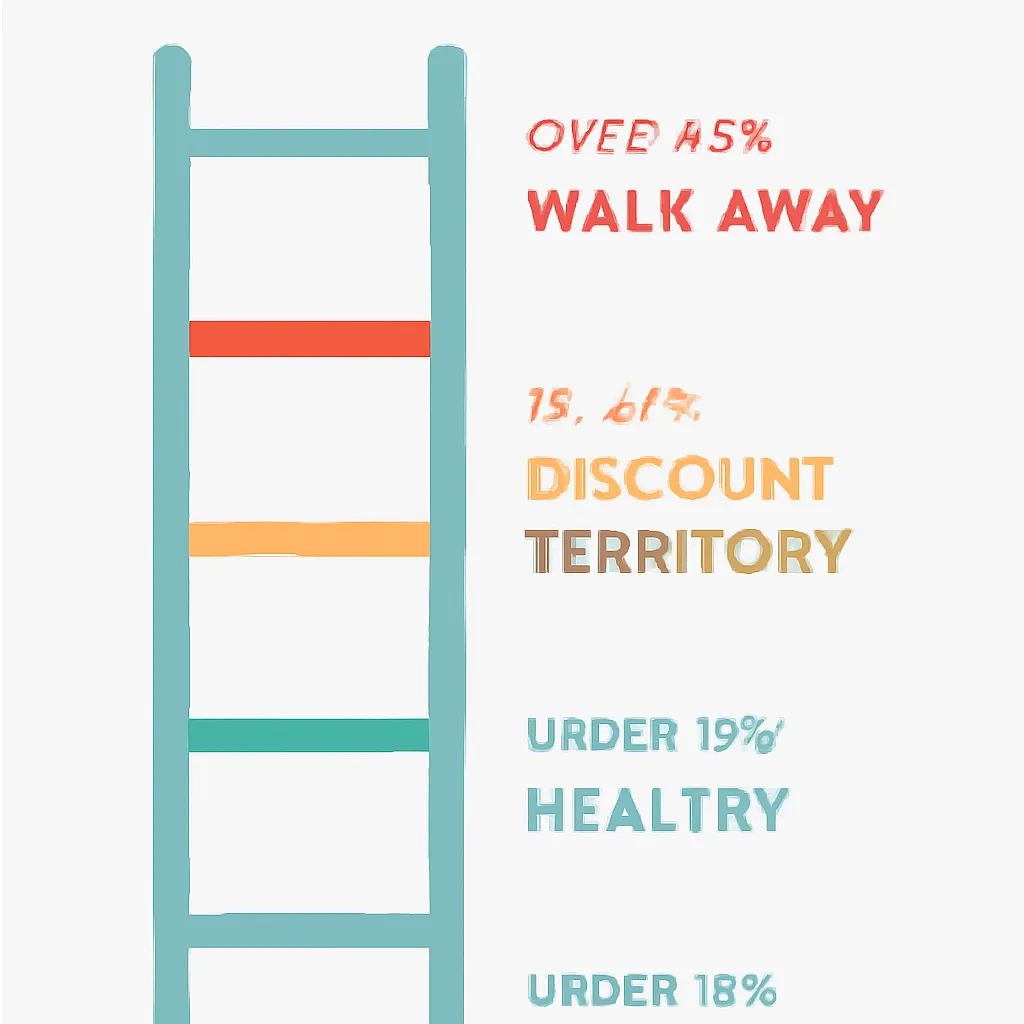
These thresholds shift slightly based on the nature of the customer. A 25% concentration in a property management company with a 5-year service contract is different from 25% in a builder who works on handshake deals. Context matters. But the math doesn’t care about context.
Residential vs. Commercial: A Natural Divide
If the business you’re looking at is 80%+ residential service and replacement, concentration is rarely an issue. You’ve got hundreds or thousands of individual customers, and losing any one of them barely registers.
The risk lives almost entirely in the commercial book. Any time you see a commercial HVAC business with strong revenue, your first question should be: “Where is it coming from, and how many people could take it away?”
How Concentration Affects What You’ll Pay
This is where the conversation gets real. Customer concentration isn’t just a red flag — it’s a valuation discount, and it’s a big one.
The Math
Industry data shows that HVAC businesses with significant customer concentration face a 0.5x to 1.0x discount on their SDE multiple. Here’s what that looks like in actual dollars.
Scenario: A clean, diversified HVAC business
- SDE: $300,000
- Market multiple: 3.5x
- Valuation: $1,050,000
Same business, but 35% of revenue comes from one builder
- SDE: $300,000
- Adjusted multiple: 2.5x–3.0x (concentration discount applied)
- Valuation: $750,000–$900,000
That’s a $150,000 to $300,000 difference. On the same revenue. The same SDE. The same trucks, the same techs, the same brand. The only difference is where the money comes from.
Some sellers will fight you on this. They’ll say the customer isn’t going anywhere, that the relationship is rock-solid, that you’re being paranoid. Maybe they’re right. But the market prices risk, and the market says concentrated revenue is risky revenue.
Why Your Lender Cares
If you’re financing the deal with an SBA loan — and most first-time buyers are — your lender’s underwriting team will flag customer concentration above 20%. This isn’t a suggestion. It’s a credit policy item.
Here’s what happens:
- 20–25% concentration: The underwriter notes it and may require additional documentation — a signed service agreement, customer confirmation letter, or explanation of the relationship.
- 25–35% concentration: You’ll likely face tighter deal terms. Higher equity injection, shorter seller note terms, or a lower approved loan amount.
- Over 35% concentration: Some lenders will decline the deal outright. Others will require specific structural protections like earnouts or retention-based seller notes.
Your lender is not being difficult. They’re protecting their money — and yours. If the key customer leaves six months after closing, the lender still needs to get paid. If the business can’t support that payment without the customer, the deal was overleveraged from day one.
Warning: If the seller hasn’t accounted for customer concentration in their asking price, don’t assume they’re being deceptive. They probably just don’t know. But that gap between their expectation and reality is where your negotiating leverage lives.
The Negotiation Opportunity
Here’s the upside of concentration: most sellers don’t price it in. They look at SDE, apply a market multiple, and list the business. They’ve never heard of a “concentration discount.”
That means if you’ve done your homework and you understand the risk, you can present a data-backed offer that’s lower than asking — and explain exactly why. Sellers respond much better to “here’s the math on why I’m offering less” than to “I just think it’s worth less.”
Come to the table with:
- The revenue breakdown showing the concentration
- Market data on how concentration affects multiples
- Your lender’s position on the issue (this is powerful — it’s not you being cheap, it’s the bank saying no)
- A proposed deal structure that protects both sides
The Due Diligence Checklist for Customer Concentration
This is the work. None of it is complicated, but all of it is essential. Skip this and you’re guessing. Guessing on a million-dollar purchase is not a strategy.
Step 1: Pull the Revenue Breakdown
Request a customer revenue report from the seller’s accounting system — top 10 customers by total billings for each of the last 3 years. Three years minimum. Five years if you can get them.
You’re looking for:
- Any single customer above 15% of total revenue in any year
- Any group of related customers (same owner, same parent company) above 20% combined
- Trends: is the concentration growing or shrinking year over year?
- Seasonal patterns: does the big customer account for 60% of revenue in Q2 but 15% in Q4?
If the seller can’t produce this report, that tells you something about their bookkeeping. It also tells you they probably don’t know their own concentration numbers.
Step 2: Investigate Every Customer Above 10%
For each customer that represents more than 10% of revenue, ask these questions:
- Is the relationship with the owner personally, or with the company? If the customer calls the owner’s cell phone to request service, that’s a personal relationship. If they call the office number and talk to the dispatcher, that’s a company relationship. This distinction is worth six figures.
- Is there a written contract or service agreement? Get a copy. Read every clause, especially the termination provisions and assignment language. A contract that says “this agreement may not be assigned without written consent” means the customer can walk at closing.
- What’s the payment history? Net-30 that’s really Net-90 is not just a concentration risk — it’s a cash flow problem. Pull the aging report for this specific customer.
- What’s the service history? How many calls per year? What type of work? Emergency repairs suggest dependency. Preventive maintenance suggests a structured relationship.
- Would this customer stay after an ownership change? Don’t accept the seller’s word. You need evidence — ideally a direct conversation with the customer during due diligence.
Step 3: Check for Hidden Concentration
This is where deals get interesting. Hidden concentration is when the books show five or six separate customers, but they’re actually controlled by one person or entity.
Look for:
- Multiple LLCs with similar names (Apex Development LLC, Apex Properties LLC, Apex Commercial LLC)
- Different company names at the same physical address
- Different entities with the same accounts payable contact
- A property manager who controls service decisions for multiple “separate” buildings
- A general contractor whose subcontracts funnel work through different project entities
I’ve seen a deal where the “top 5 customers” turned out to be one real estate developer operating under different LLCs for each property. The seller genuinely didn’t realize it was concentration — he saw five different names in QuickBooks. The buyer did the research and found one decision-maker controlling 47% of revenue. That deal got repriced by $200,000.
Step 4: Assess the Revenue Trend
Concentration that’s getting worse is a bigger problem than concentration that’s getting better.
- Is the key customer’s share of revenue growing each year? That means the business is becoming more dependent, not less.
- Has the business lost other large customers recently, making the remaining big customer look even bigger?
- Is the overall revenue growing while the key customer stays flat? That’s actually good — the business is naturally diversifying.
The Relationship Question: Does the Customer Follow the Owner or the Company?
This is the single most important question in evaluating concentration risk. A 30% customer with a transferable, contract-based relationship is a completely different animal than a 30% customer who plays golf with the owner every Saturday.
Signs the Relationship Is Owner-Dependent
These should make you nervous:
- The customer calls the owner’s personal cell phone, not the office line
- There’s no written service agreement — it’s all handshake
- The owner personally handles every issue for this customer, even minor ones
- The customer and owner socialize outside of work
- The owner says things like “they’d never leave me” or “we go way back”
- No one else at the company has a relationship with the customer’s decision-maker
- Invoicing and pricing are informal — “we work it out”
Signs the Relationship Is Company-Dependent
These are what you want to see:
- A formal, written service agreement with assignment language that allows ownership transfer
- Multiple points of contact — the customer works with your dispatcher, your lead tech, and your service manager, not just the owner
- Service quality drives the relationship, not personal loyalty
- The customer has a structured vendor management process
- Pricing is documented and consistent
- The relationship survived previous employee turnover (a tech leaving didn’t cause the customer to leave)
How to Test It
During due diligence, ask the seller to introduce you to the key customer. This is not optional. If the seller refuses, that tells you everything.
Here’s how the meeting should go:
- The seller introduces you as the potential new owner. Watch the customer’s reaction. Surprise? Concern? Indifference? All of these are data.
- You explain your plans for the business. Emphasize continuity — same techs, same response times, same quality. The customer wants to know nothing will change.
- You ask the customer directly: “What keeps you working with this company?” If the answer is “Jim’s always taken care of us,” that’s owner-dependent. If the answer is “Your response time is the best in the area and your techs know our systems,” that’s company-dependent.
- You ask about their future plans. Are they growing? Consolidating? Bringing services in-house? This tells you whether the revenue will grow, stay flat, or disappear.
Warning: If the key customer says anything like “We were actually thinking about making a change” or “We just started getting bids from other companies,” you need to seriously reconsider the deal. That revenue is already at risk regardless of the ownership transition.
How to Negotiate Around Concentration Risk

You’ve done the diligence. You understand the concentration. Now you need to structure a deal that accounts for it. Here are your tools.
1. Price Adjustment
The most straightforward approach: apply a concentration discount to your offer and explain why.
Don’t just lower the number and hope the seller accepts. Show your work:
- “Your business has $320K in SDE, which at a 3.5x multiple would value it at $1.12M.”
- “However, 35% of revenue is concentrated in one customer with no written contract.”
- “Market data indicates a 0.5x–1.0x multiple discount for this level of concentration.”
- “My offer is $880,000, reflecting a 2.75x multiple.”
Sellers push back less when you explain the math. They push back a lot when you just lowball them without context.
2. Seller Note with Retention Clause
This is the most elegant solution for both sides. Structure it like this:
- Purchase price: $1,000,000
- Bank financing: $750,000 (SBA 7(a) loan)
- Seller note: $150,000 (15% of purchase price)
- Buyer equity: $100,000
The seller note includes a retention clause: if the key customer leaves or reduces spending by more than 30% within 18 months of closing, the remaining balance of the seller note is reduced proportionally.
The seller gets a higher headline price. You get downside protection. If Apex stays, the seller gets paid in full. If Apex leaves, you’re not stuck paying for revenue that evaporated. Both parties are aligned on making the transition work.
3. Earnout Tied to Customer Retention
Similar concept, but structured as a bonus rather than a clawback:
- Base purchase price: $850,000 (reflects the concentration discount)
- Earnout: up to $150,000, paid if the key customer generates at least 80% of their historical revenue for each of the first two years post-closing
- Year 1 retention target met: $75,000 paid to seller
- Year 2 retention target met: $75,000 paid to seller
This keeps the seller motivated to help with the transition. They have real money on the line if they just cash out and disappear while their best customer follows them out the door.
4. Transition Period Requirements
Regardless of the deal structure, require the following in your purchase agreement:
- The seller personally introduces you to every customer representing more than 10% of revenue
- The seller remains available for customer relationship support for a minimum of 90 days post-closing (this should be a paid consulting arrangement)
- The seller provides written notice to all key customers about the ownership transition, endorsing you as the new owner
- Any personal service agreements or handshake deals are formalized into written contracts before closing
5. Define Your Walk-Away Line Before You Get Attached
This is the hardest one, and it has nothing to do with deal structure. Before you get deep into negotiations, before you start picturing your name on the building, write down your criteria for walking away.
Something like:
- “If concentration exceeds 40% and there’s no transferable contract, I walk.”
- “If the key customer won’t meet with me during due diligence, I walk.”
- “If the lender won’t approve the deal at terms that work, I walk.”
Write it down. Show it to your spouse, your accountant, your broker. When deal fever hits — and it will — you need something concrete to pull you back to reality.
Warning: Deal fever is real. You’ve spent three months on due diligence, $15,000 on attorneys and accountants, and you’ve already mentally moved into the office. Walking away at that point feels like failure. It’s not. Walking away from a bad deal is the second-best outcome. The best outcome is never getting to the table with a bad deal in the first place.
What to Do After You Buy a Concentrated Business
Let’s say you’ve done the diligence, negotiated the discount, structured the protections, and closed the deal. You now own a business where one customer is 30-something percent of your revenue.
Your job for the next 12 months is simple to describe and hard to execute: reduce that number below 25%.
Don’t Fire the Big Customer
I need to say this because I’ve seen it. A new owner gets so nervous about concentration that they start pulling back from the big customer, turning down work, letting response times slip. The customer notices and leaves. The owner panics.
The big customer is paying your bills right now. They’re not the problem. The lack of other customers is the problem. You fix concentration by growing around the big customer, not by shrinking them.
The 12-Month Diversification Plan
First 30 days:
- Meet with the key customer face-to-face. Reinforce the relationship. Assure them nothing changes except the name on the checks.
- Audit your current customer list. Who are the small commercial accounts that could grow? Who haven’t you heard from in a while?
- Identify 5–10 potential new commercial customers in your service area.
Days 31–90:
- Start outreach to 2–3 new commercial prospects. Property managers, facility directors, small builders. You’re not trying to land a whale — you’re trying to add three medium-sized fish.
- Launch or expand a residential service agreement program. Service agreements are the antidote to concentration. Each one is small, predictable, recurring revenue that doesn’t depend on any single relationship.
- Review your pricing with the key customer. Concentrated businesses often underprice their biggest customer because they’re afraid to lose them. If Apex is getting a 15% discount that nobody else gets, you’re subsidizing your own risk.
Days 91–180:
- You should have at least one new commercial account producing revenue by now. If not, double down on business development.
- Track your concentration percentage monthly. Put it on a dashboard. Make it a KPI your team knows about.
- Start building relationships at the key customer’s organization beyond your main contact. Know the project managers, the site supervisors, the AP clerk. If your one contact leaves, you need other threads.
Days 181–365:
- Target: key customer below 25% of revenue, not because they shrank but because everything else grew.
- Evaluate whether a formal service agreement with the key customer makes sense now that you’ve built trust.
- Start thinking about your next year’s growth plan with concentration as a permanent lens.
The Monthly KPI
Track these numbers every month:
- Top customer as a percentage of trailing 12-month revenue
- Top 5 customers as a percentage of trailing 12-month revenue
- Number of customers representing more than 10% of revenue
- Number of new commercial accounts added this quarter
- Service agreement count and recurring revenue from agreements
You managed refrigerant pressures and airflow calculations for years. This is just a different set of numbers. And they matter just as much to the health of your business as a proper superheat reading matters to a compressor.
The Bottom Line
Customer concentration is a real risk, but it’s a known risk. And known risks can be priced, negotiated, and managed.
The buyers who get burned are the ones who either don’t look for it or see it and don’t adjust their offer. The buyers who do well are the ones who say: “I see this risk. Here’s what it means for the price. Here’s how I want to structure the deal. And here’s my plan to fix it after closing.”
That’s not walking away from opportunity. That’s walking toward it with your eyes open.
If you’ve been turning wrenches for a decade and you’re ready to own the company, this is exactly the kind of analysis that separates the techs who buy businesses from the techs who buy problems. The math is learnable. The diligence is doable. And the negotiation is a lot less intimidating when you’ve got real numbers backing up every word.
Do the work. Run the numbers. And if the deal still makes sense after you’ve accounted for the risk, go build something.