
Carrier Factory Authorized. Trane Comfort Specialist. Lennox Premier. These designations come with real money — and they may not survive your purchase agreement.
The seller told you the company is a “Carrier Factory Authorized Dealer.” You nodded. It was somewhere between the fleet walkthrough and the conversation about service agreement revenue. You checked the books, inspected the trucks, talked to the techs. Solid business.
But let me ask you something: does that Carrier designation transfer when you sign the purchase agreement?
Because if it doesn’t — and there’s a real chance it won’t — you just lost five figures of annual revenue that wasn’t on any line item you reviewed. No one lied to you. It just never came up. And by the time you figure it out, you’re six months into ownership, operating without co-op dollars, volume rebates, or preferred pricing, wondering why your margins are thinner than the seller’s ever were.
I’ve watched this happen. More than once.
What Manufacturer Dealer Programs Actually Include
The big three — Carrier Factory Authorized, Trane Comfort Specialist, and Lennox Premier Dealer — aren’t just stickers on your truck. They’re revenue programs disguised as marketing badges.
Here’s what you actually get at the top tiers:
- Co-op advertising funds: 1–3% of your annual equipment purchases, paid back to fund local marketing. The manufacturer subsidizes your Google Ads and mailers.
- Volume rebates: Tiered rebates on annual purchases. Hit your volume target, get 2–5% back at year-end. Miss it by a single unit, get nothing.
- Preferred pricing: 5–15% below standard dealer cost on equipment. This is the big one. It’s baked into every job you bid.
- Priority warranty support: Your warranty claims move faster. Parts ship sooner. Your customer isn’t sitting in a 90-degree house for a week.
- Dealer locator listings and leads: The manufacturer’s website sends homeowners directly to you. Free inbound leads with high purchase intent.
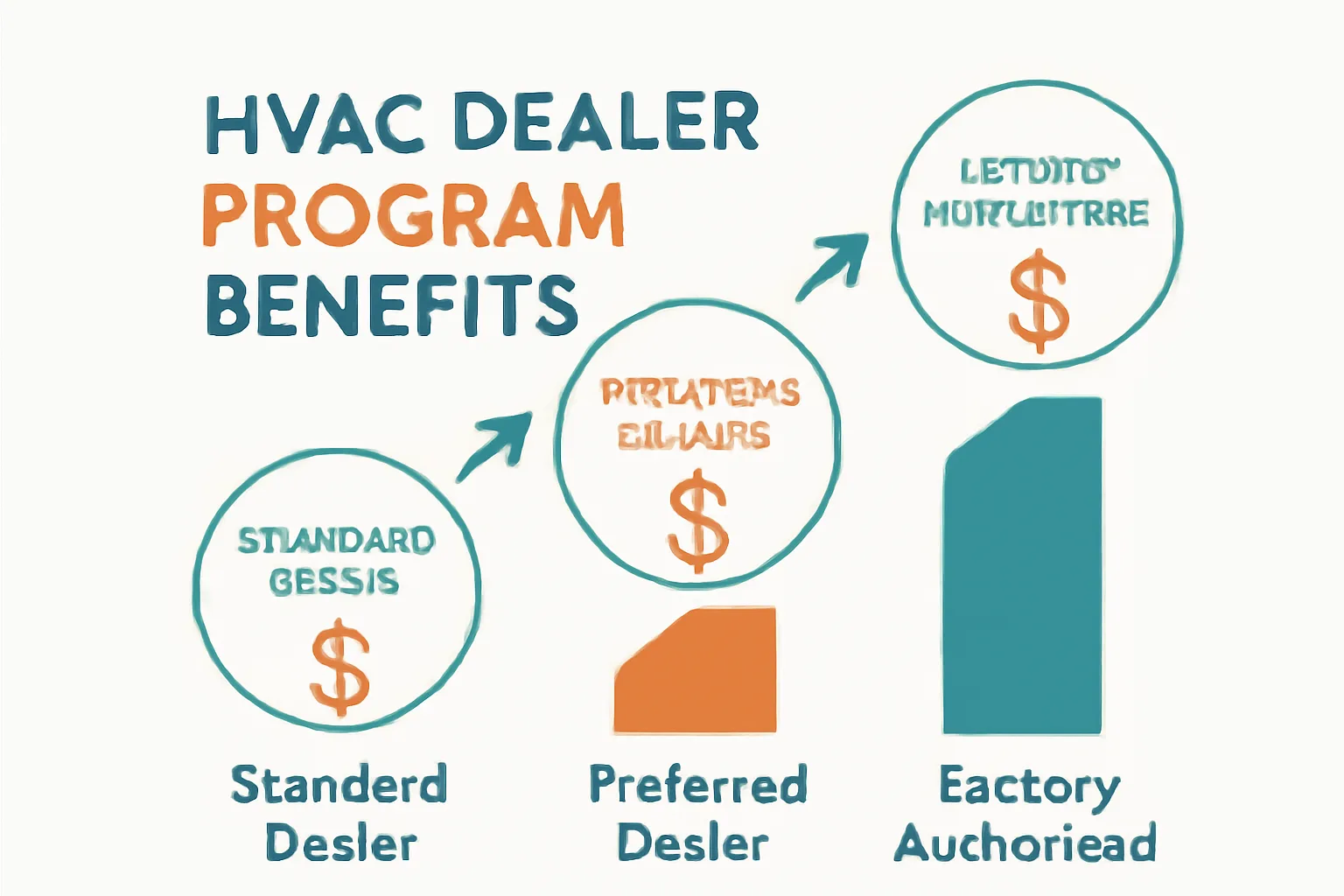
These programs are tiered. A dealer who installs 50 systems a year doesn’t get the same deal as one who installs 300. The top tier is where the real money lives — and that’s exactly the tier that’s hardest to maintain through an ownership change.
The programs nobody reads
Beyond the big brand programs, most manufacturers run quarterly and annual SPIFs, early-buy programs, and seasonal promotions. A Carrier dealer might get an extra $150 per unit on a specific model line during a spring push. Multiply that across 40 installs and you’ve got $6,000 that only shows up if you know to look for it.
The seller may not even think of these as “programs.” They’re just the way business works. Which is exactly why they fall through the cracks in due diligence.
The Dollar Value Most Buyers Never Calculate
Let me walk you through the math on a mid-market HVAC company. Nothing exotic — just a solid residential shop.
Assumptions: 200 system installs per year. Average wholesale equipment cost: $4,000 per system. Annual equipment spend: $800,000.
Now stack the manufacturer benefits:
| Benefit | Rate | Annual Value |
|---|---|---|
| Co-op advertising | 2% | $16,000 |
| Volume rebate | 3% | $24,000 |
| Preferred pricing delta | ~5% | $40,000 |
| Dealer locator leads | est. | $8,000–$12,000 |
| Total | $88,000–$92,000 |
That’s $88K to $92K in annual value that doesn’t show up as a line item called “manufacturer program revenue.” It’s buried in your COGS (lower equipment cost), your marketing budget (co-op offsets), and your lead flow (dealer locator traffic).
On a business with $350K in SDE, losing these programs represents a 25% hit to your cash flow. And here’s the part that should make you set down your coffee: most buyers never model this. They see the seller’s margins and assume they’ll inherit them.
You won’t inherit them. You have to earn them. Or negotiate them.
With April 2026 equipment price increases already squeezing margins across the board, losing preferred pricing on top of that is a double hit you can’t afford to absorb.
What Happens to Dealer Status When Ownership Changes
This is where acquisitions get quietly expensive.
Re-application is the default
Most manufacturer dealer programs require re-application when ownership changes. The designation belonged to the previous owner’s entity. In an asset sale — which is how the majority of HVAC deals are structured — the program agreement doesn’t transfer. Full stop.
Even in a stock sale where the legal entity survives, manufacturers typically have change-of-control provisions. New ownership triggers a review. You’re not automatically grandfathered in.
The NATE certification problem
Carrier, Trane, and Lennox all require a minimum number of NATE-certified technicians on staff. These certifications belong to the individual techs, not the company. If your best certified tech leaves during the ownership transition — and technician turnover during acquisitions is real — you may not meet the minimum.
Worse: some programs require recertification under the new ownership entity. The training hour clock resets. Your techs need to complete manufacturer-specific training modules again, which takes time they could be running calls.
Volume thresholds reset
Here’s the one that catches even sophisticated buyers. Your tier status is based on trailing 12-month purchase volume. When you re-apply as a new dealer, you may start at the base tier regardless of the company’s historical volume.
A company that was installing 200 systems and sitting comfortably at the top tier? Under your new dealer number, you’re at zero. You need to hit the volume threshold all over again — and you’re doing it without the preferred pricing that made those jobs profitable in the first place.
The gap period
Re-qualification takes 6–12 months in most programs. During that gap, you’re operating without co-op funds, without volume rebates, and at standard dealer pricing. You’re running the same business with structurally worse economics.
That gap is real money. Go back to the math: $88K in annual program value means you’re losing roughly $7,300 per month during the re-qualification period. A 9-month gap costs you $66,000.
Nobody told you about that cost because nobody thought to ask.
The Due Diligence Checklist for Manufacturer Programs
Don’t rely on the seller’s verbal representation. “Yeah, we’re Carrier Factory Authorized” tells you nothing about whether that status survives closing.
Here’s what you actually need:
- Request the dealer agreement. It’s a contract between the manufacturer and the company. Read it like one. Look for change-of-control clauses, volume minimums, and termination provisions.
- Call the manufacturer’s regional rep directly. Don’t ask the seller to relay information. Get the rep on the phone and ask: what happens to this dealer’s status when ownership changes? What’s the re-qualification process? What’s the timeline?
- Document the current tier and calculate the annual value at risk. Use the framework above. Get exact numbers for co-op, rebates, and pricing deltas. The seller should be able to pull this from their annual manufacturer statements.
- Check competitor exclusivity. Some programs prohibit selling competing brands. If the seller is Carrier-exclusive, you need to know if that restriction transfers — and whether you want it to. More on this below.
- Verify NATE certs on every tech you’re retaining. Don’t assume. Pull the actual certification records. Check expiration dates. If you’re keeping six techs and only three are NATE-certified, you need to know before closing — not after your re-application gets rejected.
- Review ACCA standards compliance. Several manufacturer programs require ACCA membership or adherence to ACCA quality installation standards. Confirm the company is current and compliant.
If you’ve already been through the vendor relationship transfer analysis, this is the manufacturer-specific layer on top. Same principle, higher stakes.
Protecting Yourself in the Purchase Agreement
Due diligence tells you what you’re dealing with. The purchase agreement is where you protect yourself from it.
Representation and warranty on dealer status
The seller should represent and warrant that all manufacturer dealer designations are current, in good standing, and — critically — that they’re not aware of any reason the manufacturer would decline to transfer or re-issue the designation to the buyer.
This matters because if the seller knows they’ve been on probation, failed an audit, or received a warning letter from the manufacturer, that needs to be disclosed. A general rep/warranty on “all material contracts” might not be specific enough. Name the programs explicitly.
Transition assistance clause
Require the seller to actively assist with re-qualification. That means:
- Introducing you to the manufacturer’s regional rep before closing
- Providing all documentation needed for your application
- Remaining available for 90 days post-close to support the transition
- Attending the manufacturer’s review meeting if requested
This dovetails with your dealer authorization transfer strategy. The seller’s cooperation isn’t optional — it’s a deal term.
Price adjustment if status doesn’t transfer
Here’s where it gets real. If the manufacturer declines to transfer the dealer designation — or downgrades you to a lower tier — the economics of the deal change. Your purchase agreement should reflect that.
Options include:
- Escrow holdback: A portion of the purchase price held in escrow pending successful program transfer. Release it when you’re re-qualified. Keep it if you’re not.
- Purchase price reduction: A defined adjustment if tier status drops. Calculate it based on the annual value at risk and a reasonable re-qualification timeline.
- Earn-out component: Tie a portion of the price to your ability to achieve the same manufacturer tier within 12 months — with the seller’s transition assistance.
Pre-closing introduction to manufacturer rep
This is non-negotiable. You need to meet the regional rep before you close. Not after. Before.
You want to hear directly from the manufacturer: will they work with you? What do they need? Is there any issue with the current dealer that might complicate your application? You do not want surprises on this one.
If you’re comparing franchise dealer vs. independent models, the transfer complexity is a major factor in that decision.
When Losing Dealer Status Is Actually an Opportunity
I know. I just spent 1,500 words telling you how much money these programs are worth. And they are. But sometimes losing them is the right move.
Brand diversification
If the seller was locked into Carrier exclusivity, they could only sell Carrier equipment. That’s fine when Carrier’s product line covers every application. It’s less fine when a customer wants a Mitsubishi mini-split and you have to turn down the job or violate your agreement.
An ownership change gives you a clean slate. You can re-apply to the Carrier program without the exclusivity clause. Or you can add Trane, Lennox, or Daikin lines and offer customers options that the previous owner couldn’t.
Restrictive program requirements
Some manufacturer programs dictate how you market, what you charge, and how you handle warranty work. The requirements made sense when the seller built the business around that brand. They might not make sense for your growth plan.
If you’re planning to expand into commercial work, add a second location, or shift toward high-efficiency heat pump installs, a single-brand restriction could hold you back.
The math on re-qualification vs. independence
Run two scenarios:
Scenario A: Re-qualify at the top tier. Spend 6–12 months at reduced benefits. Regain $88K in annual value. Accept the exclusivity and program requirements.
Scenario B: Go independent. Negotiate directly with multiple distributors. Build your own distributor credit relationships. Sacrifice manufacturer program benefits but gain pricing flexibility and brand diversification.
Scenario B isn’t always worse. If the company’s revenue is heavily service and repair — not install-dependent — the manufacturer programs matter less. If you’re planning to diversify into brands the seller didn’t carry, independence gives you room.
Run the math. Don’t assume the incumbent program is automatically the right answer just because the seller built the business around it.
The Bottom Line
Manufacturer dealer status is one of the highest-value intangible assets in an HVAC acquisition, and it’s one of the most commonly overlooked. It doesn’t appear on the balance sheet. It doesn’t show up in the SDE add-back schedule. It quietly subsidizes the business’s economics by tens of thousands of dollars a year — and it can quietly disappear the day you close.
Ask the question before you sign the LOI. Get the dealer agreement during due diligence. Protect yourself in the purchase agreement. And if the programs don’t transfer, make sure the deal price reflects that reality.
The seller’s Carrier plaque on the wall is impressive. Just make sure it’s not the most expensive piece of wall art you’ve ever bought.


