
You’re running through the due diligence checklist. Financial statements. Fleet condition. License transfer. Service agreements. Nobody — and I mean nobody — has a line item for the Google Business Profile. That’s a $40,000 oversight hiding in plain sight.
You’re about to buy an HVAC company. You’ll spend weeks on the P&L. You’ll get the VINs on every van and pull mileage reports. You’ll read the service agreement language until your eyes blur.
And then you’ll hand over a check without ever asking: what does this company’s online reputation actually look like? Who owns the Google Business Profile? What happens to those 312 five-star reviews in an asset sale?
98% of consumers read online reviews before contacting a local business. For HVAC — where you’re inviting a stranger into your home to fix something that costs several thousand dollars — that number approaches 100%. A business with 400+ Google reviews and a 4.7-star average is generating leads daily without spending a dollar on ads. A business with 3.2 stars and a pattern of unresolved complaints is actively repelling them.
Neither of those shows up in the financial statements. Both of them affect what the business is worth.
Why HVAC Buyers Leave Digital Assets on the Table
Most first-time buyers come from the trades. They know how to evaluate a refrigerant leak. They know when a fleet’s been deferred into the ground. They don’t think about Google reviews because that’s “marketing stuff.”
The trade press doesn’t help. The DealStream HVAC due diligence guide dedicates one bullet point to digital presence: “analyze customer feedback.” That’s it. One sentence for an asset that could be worth tens of thousands of dollars annually in organic lead generation.
Here’s why this gap exists: digital reputation is hard to put a dollar figure on. Unlike a van or a piece of equipment, you can’t depreciate it. It doesn’t show up on the balance sheet. So buyers skip it.
The sellers know better. The ones who built strong reputations know exactly what those reviews are worth. The ones who wrecked their reputation are quietly hoping you won’t look. This belongs alongside the other red flags and deal killers in your due diligence process.
Look.
The Google Business Profile: What It Is and Who Actually Owns It
Google Business Profile (GBP) is the listing that appears when someone searches “AC repair near me” or “HVAC company in [city].” It shows the company name, address, phone number, hours — and most importantly, the reviews.
A well-optimized GBP with strong reviews shows up in the Google Map Pack: the top three local listings that appear above organic search results. That placement is free advertising. Businesses in the Map Pack get the majority of clicks for local service searches.
Here’s the part that bites buyers who aren’t paying attention.
Google Business Profile is tied to a Google account — not to the legal business entity. When you buy an HVAC company, the GBP doesn’t automatically transfer to you. The seller controls access to the account it’s managed from. If that account gets deactivated, suspended, or simply isn’t transferred in the deal, you can lose access to everything built up on that profile.
This matters differently depending on deal structure.
Asset Sale vs. Stock Sale: The GBP Difference
In a stock sale, you’re buying the entity itself. The GBP is tied to that entity’s Google Workspace account or personal Google account. As long as the account credentials transfer with the deal — which they should be explicitly listed in the purchase agreement — the profile and all its reviews stay intact.
In an asset sale, you’re buying specific assets. The GBP is typically not listed as a named asset, which means its transfer isn’t guaranteed. The seller could claim management rights over the profile after closing. Even if they don’t, Google may flag the profile for review if the business address, phone number, or name changes as part of the acquisition.
What to do about it:
- List “Google Business Profile management access” explicitly as a transferred asset in the purchase agreement
- Confirm the email address currently managing the GBP and have it transferred to a new account you control
- Do not change the business name, address, or phone number immediately after closing — sudden changes trigger Google’s spam filters and can cause a suspension that takes weeks to resolve
Get a GBP expert (or at minimum someone who’s done this before) to manage the transfer. It’s a $500 task that protects potentially $50,000+ in digital infrastructure. Once the transfer is complete, you can start implementing your own post-acquisition marketing strategy.
How to Audit a Target’s Review Health
Before you sign an LOI, spend 90 minutes on this. It costs nothing and tells you a lot.
1. The Volume Check
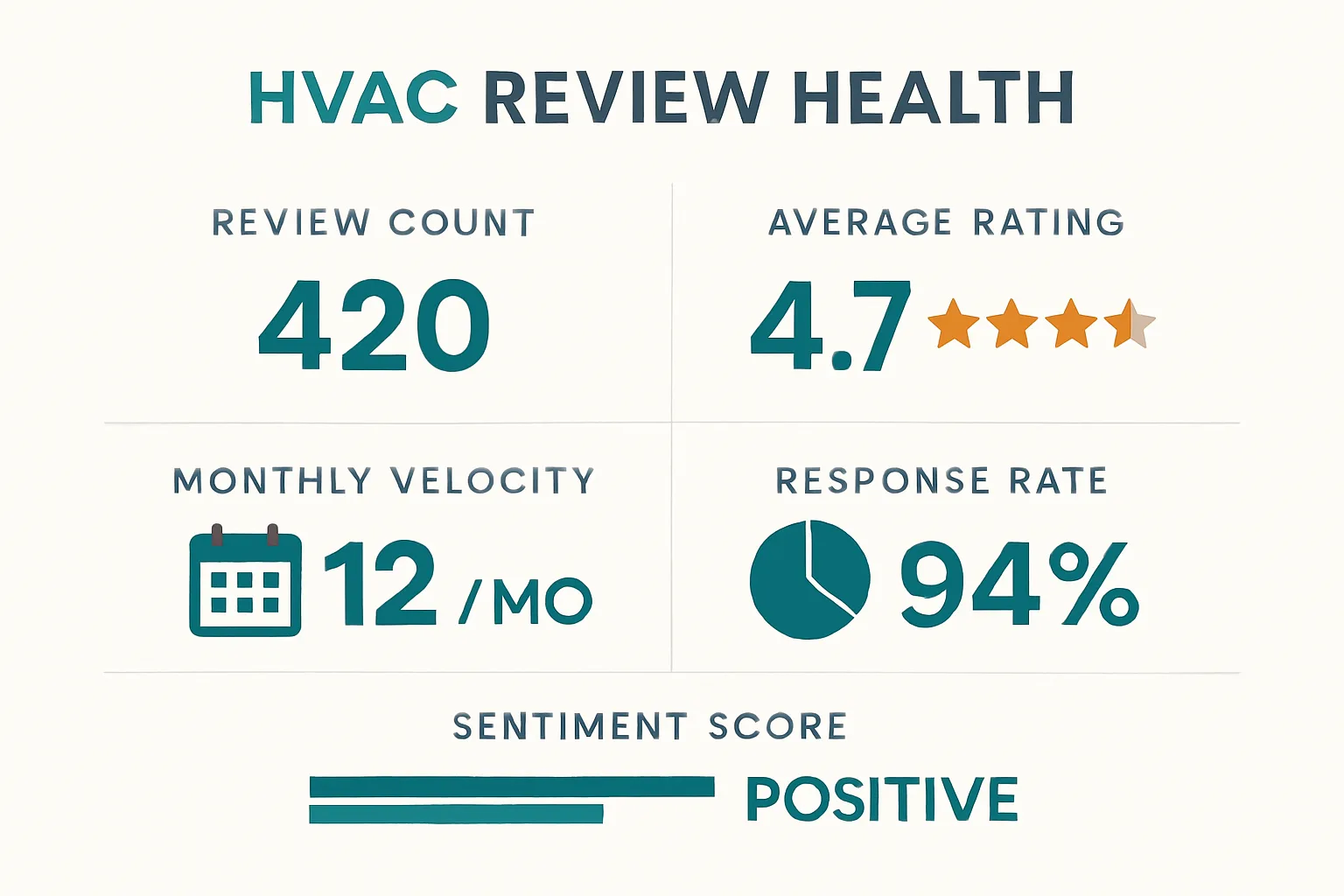
Pull up the Google Business Profile. How many reviews does the business have?
- Under 50: The company has no real digital presence. This is a blank slate — it’s not a deal-killer, but there’s no digital asset to acquire either. (More on why that’s actually an opportunity in a moment.)
- 50–150: A modest presence. Enough to be credible to customers actively researching the company, but not enough to drive significant organic lead flow.
- 150–400: A real asset. This took years to build. Customers are actively choosing this company based on its reviews.
- 400+: A significant competitive advantage. This company is likely showing up consistently in the Map Pack.
Volume matters. But it’s not the whole story.
2. The Rating Check
4.5 stars or above means customers are actively satisfied. Below 4.0 means something systemic is wrong.
The threshold that actually matters for local service businesses is 4.3. Below that, research shows a measurable drop in conversion. You might still get calls, but more people click to the next result instead.
Don’t just look at the current rating. Look at the trend.
Filter reviews by most recent. If the business had 200 reviews averaging 4.7 and the last 40 reviews average 3.9, something changed — a bad technician, an operational breakdown, a billing dispute that went sideways. The current overall rating disguises an active reputation crisis.
3. The Recency Check
Google’s algorithm weights recent reviews heavily. A business with 500 reviews but the last five dated eight months ago will perform worse in search than a business with 180 reviews and two new ones last week.
Ask the seller: what’s your process for collecting reviews from customers?
The answer tells you everything about whether that review count is a managed asset or a happy accident.
A managed process — following up by text after every job, asking in a scripted way at the right moment — produces consistent velocity. This review system is part of the broader customer relationship infrastructure that includes service agreements. That velocity signals to Google that the business is active, which improves ranking. A happy accident means reviews trickle in when someone’s really delighted or really angry. That’s not a system. And it’s not something you can count on continuing.
4. The Sentiment and Response Check
Read the one-star reviews. All of them.
Then categorize them. Are you seeing:
- Isolated incidents: A customer who was unreasonable, an unlucky job, a misunderstanding. These happen to every business. They’re fine.
- Operational patterns: “They didn’t show up.” “The tech was an hour and a half late.” “I had to call three times.” If you see the same complaint in more than 15% of negative reviews, it’s baked into the operation.
- Billing disputes: “They charged me for parts they said were included.” “The quote was $800 and the invoice was $1,400.” These often correlate with trust problems that are very hard to fix.
Now look at how the business responds to reviews — especially the negative ones.
A business that responds promptly, professionally, and without getting defensive is a business that’s managing its reputation actively. That’s a skill that carries forward.
A business with 23 unanswered one-star reviews is signaling to every potential customer that nobody’s home.
Website and SEO: The Invisible Lead Generation Engine
The Google Business Profile is the most visible piece of the digital footprint. The website is the engine underneath it.
An HVAC website doing real SEO work is generating inbound leads every month without a marketing budget. That’s real money. It’s also an asset that’s hard to build from scratch and takes 12–18 months of consistent effort to establish.
What to Audit
Domain age. How old is the domain? Older domains carry more authority with Google. A 12-year-old domain is meaningfully more valuable than a 2-year-old one. Check this at WHOIS.
Organic traffic. Use a free tool like Ahrefs’ free tier, Semrush’s trial, or Ubersuggest to check organic keyword rankings and estimated monthly traffic. You’re looking for evidence that the site ranks for commercial-intent local terms: “AC repair [city],” “HVAC company [city],” “furnace installation [city].” Ranking on page one for these terms means free leads every month.
Backlink profile. Links from local business directories, local news sites, and home services aggregators build domain authority. You’re not looking for hundreds of links. You’re looking for consistency and quality — local relevance matters more than volume.
Technical condition. Ask your broker or a web developer to do a quick audit. Is the site mobile-friendly? Does it load fast? Does it have HTTPS? Basic technical problems tank SEO performance and are cheap to fix.
What the Numbers Mean in Dollars
An HVAC website ranking on page one for 15–20 local service terms might drive 80–120 organic visitors per month. At an industry average 3–5% conversion to inquiry and $3,000–$5,000 average job value, that’s significant lead value — potentially $15,000–$40,000 in monthly job value from free organic traffic.
That’s not hypothetical. That’s what an established local HVAC SEO presence generates in a mid-sized market.
If the business you’re evaluating has that kind of digital presence, you’re not paying for it in the asking price. It’s not in the SDE. It’s not in the multiple. It’s effectively free, and it’s yours the day you close.

The Digital Due Diligence Checklist
Use this during the first two weeks of due diligence. None of it requires special tools or outside expertise. Do it yourself in an afternoon.
Google Business Profile
- Record the current review count, average rating, and date of most recent review
- Filter to “Newest first” — note the average rating of the last 20 reviews
- Identify the trend: is the rating improving, stable, or declining?
- Read every one-star review; categorize complaints (isolated vs. pattern)
- Note whether the business responds to reviews, and how
- Confirm who manages the GBP (name, email, account owner)
- Request formal transfer of GBP management access as part of deal terms
Website and SEO
- Note the domain age (WHOIS lookup)
- Check mobile usability (Google Mobile-Friendly Test — free)
- Run a free organic keyword check (Ubersuggest, Ahrefs free, or Semrush trial)
- Document which local HVAC terms the site ranks for, and on what page
- Note estimated monthly organic traffic
- Check whether the site has a blog or content strategy driving ongoing SEO value
- Confirm domain ownership transfers in deal documents
Directory and NAP Consistency
- Run the business through Moz Local or BrightLocal for a free consistency check
- Note any listings with outdated addresses, wrong phone numbers, or duplicate entries
- Check Yelp, BBB, Angi/HomeAdvisor, and Thumbtack for review count and ratings
- Check for an active BBB complaint history (bbb.org — free)
Reputation Risk Assessment
- Categorize the review profile: clean asset, mixed, or damaged?
- Estimate remediation cost if the reputation needs rebuilding
- Confirm whether the seller has a systematic review collection process in place
- Ask the seller: “What’s your current average monthly review count?”
- Ask the seller: “How do you respond to negative reviews?”
Frequently Asked Questions
Do Google reviews transfer when you buy an HVAC business?
They stay on the Google Business Profile, which is associated with a Google account — not the legal entity. The reviews transfer if the GBP management access transfers. In a stock sale, this usually happens automatically when account credentials change hands. In an asset sale, GBP transfer must be explicitly negotiated and documented. If GBP access is not transferred, you can claim ownership of the listing directly through Google, but it’s a slower, more complicated process.
How many Google reviews does an HVAC company need to compete for Map Pack placement?
There’s no official threshold from Google, but in most mid-sized markets, consistent Map Pack placement requires 100+ reviews with a rating above 4.3. In competitive markets (metro areas with multiple well-reviewed competitors), you need 250+ reviews and strong recency — new reviews consistently coming in — to hold a top-three position.
What’s a 4.7-star Google rating actually worth in dollar terms?
It’s not directly monetizable, but the business impact is measurable. Businesses in the Google Map Pack with 4.5+ ratings generate meaningfully more clicks than lower-rated competitors. In an HVAC company doing $1.5M in revenue with a 15% marketing budget, a strong organic and GBP presence can realistically reduce paid acquisition costs by $20,000–$50,000 annually compared to a business with no digital footprint. That’s a real number, and it should factor into how you value the business.
Can you fix a bad Google rating after acquiring an HVAC business?
Yes, but not quickly. Moving from 3.2 to 4.3+ requires aggressively collecting new positive reviews for 12–18 months while delivering flawless service. Existing negative reviews don’t go away (unless they violate Google’s policies). The business will operate below its potential rating during the entire recovery period. Plan for it — budget for paid advertising to compensate for lower organic performance during remediation.
What’s the difference between a Google Business Profile and organic website SEO?
The Google Business Profile drives Map Pack visibility — those top three results that appear with a map when you search for a local service. Website SEO drives organic rankings — the list of blue links below the map. A strong HVAC business needs both. The GBP gets you in front of customers ready to call right now. Organic website rankings reach customers doing longer research. Both have value; neither substitutes for the other.
Should I pay more for an HVAC business with a strong digital presence?
The current valuation convention doesn’t formally price digital assets into HVAC multiples. In practice, you’re getting digital infrastructure for free when you buy a business with strong reviews and SEO. Whether to formally negotiate a higher price for this depends on the quality of the asset — a 400-review, 4.8-star profile with verified Map Pack placement and organic keyword rankings is worth a meaningful premium over a business with no digital presence. Quantify it. Don’t just assume it’s already priced in.
The Takeaway
Every HVAC acquisition checklist tells you to verify the AR aging report. The fleet VINs. The license status. The insurance certificates.
Almost none of them tell you to audit the Google reviews, transfer the GBP access, check the organic keyword rankings, or factor the online reputation into your valuation.
That’s a gap — and gaps are either opportunities or traps, depending on whether you see them before you sign.
A strong digital footprint is free lead generation you’re inheriting. It’s worth real money, and it took years to build. A damaged reputation is a liability you’ll be managing during the exact period when you have the least bandwidth to manage anything extra.
Add the digital due diligence checklist to your process. Spend the afternoon. It’ll tell you more about how this business actually performs in the market than a lot of what’s in the financial statements.
The financial statements tell you what happened inside the business. The Google reviews tell you how customers experienced it. Both of them are telling you the truth — just about different things.


Social Media and Directory Listings
Social media for HVAC is mostly noise. Facebook has some value for local brand awareness. Instagram is largely irrelevant for service businesses. Nextdoor is underrated — neighbors recommending HVAC companies to neighbors is exactly how service reputation spreads at the neighborhood level.
Don’t pay a premium for social media presence. It’s hard to monetize and easy to rebuild.
Directory listings are different.
Consistent NAP (Name, Address, Phone) data across directories — Angi, HomeAdvisor, Yelp, BBB, Thumbtack, Yellow Pages, local Chamber listings — signals legitimacy to Google. Inconsistent data confuses both Google and customers.
When you audit the business, run the company name through Moz Local (free check) or BrightLocal. It’ll show you every directory listing and flag inconsistencies. If the address on Yelp still shows the old shop location from five years ago, that’s suppressing local search visibility.
This is a fixable problem. But you need to know it exists.